

4 Years of Ryzen 5, CPU & GPU Scaling Benchmark
In our final massive CPU and GPU scaling benchmark, we put Zen 3 series processors to the test, and while the results weren't terribly surprising, they were useful and most of you seemed to agree. We also did say that those "boring" results would pave the way for far more than interesting benchmarking, so here we are today.
This fourth dimension, we're comparison AMD'due south six-core Ryzen processors using a range of quality settings, resolutions and GPUs, and the results are extremely interesting... and not simply for the reasons we idea they would exist.
For this one we want to see how the Ryzen 5 1600X, 2600X, 3600X and 5600X compare in half a dozen games using the GeForce RTX 3090, RTX 3070, Radeon RX 5700 XT and 5600 XT, using both the ultra and medium quality presets at 1080p, 1440p and 4K.

There's a lot to get over here, so we're going to spring into the results as quickly as possible.
If you lot're wondering why nosotros didn't utilise more Radeon GPUs similar the RX 6900 XT and 6800 in identify of the RTX 3090 and RTX 3070, there are two master reasons: most of you are interested in buying a GeForce 30 serial GPU and most of you accept, at least according to a recent poll we ran. Also, it shouldn't matter as they represent a similar performance tier, though as you're about to run into our decision to utilize the Ampere GPUs has led to the discovery of some very interesting results.

Our test platform consisted of 32GB of DR4-3200 CL14 memory in a dual-channel, dual-rank configuration for all CPUs, on the Gigabyte X570 Aorus Xtreme. Cooling them is the Corsair iCUE H115i Elite. Besides loading XMP, no other changes take been made to the BIOS. Permit'southward get into the results...
Benchmarks
Cyberpunk 2077
Boot starting our session is Cyberpunk 2077 using the ultra quality preset at 1080p, and the results are more often than not as expected. Using the Radeon 5700 XT or 5600 XT all four CPUs delivered the same level of performance, though we are looking at sub-60 frame rates with even the 5700 XT.
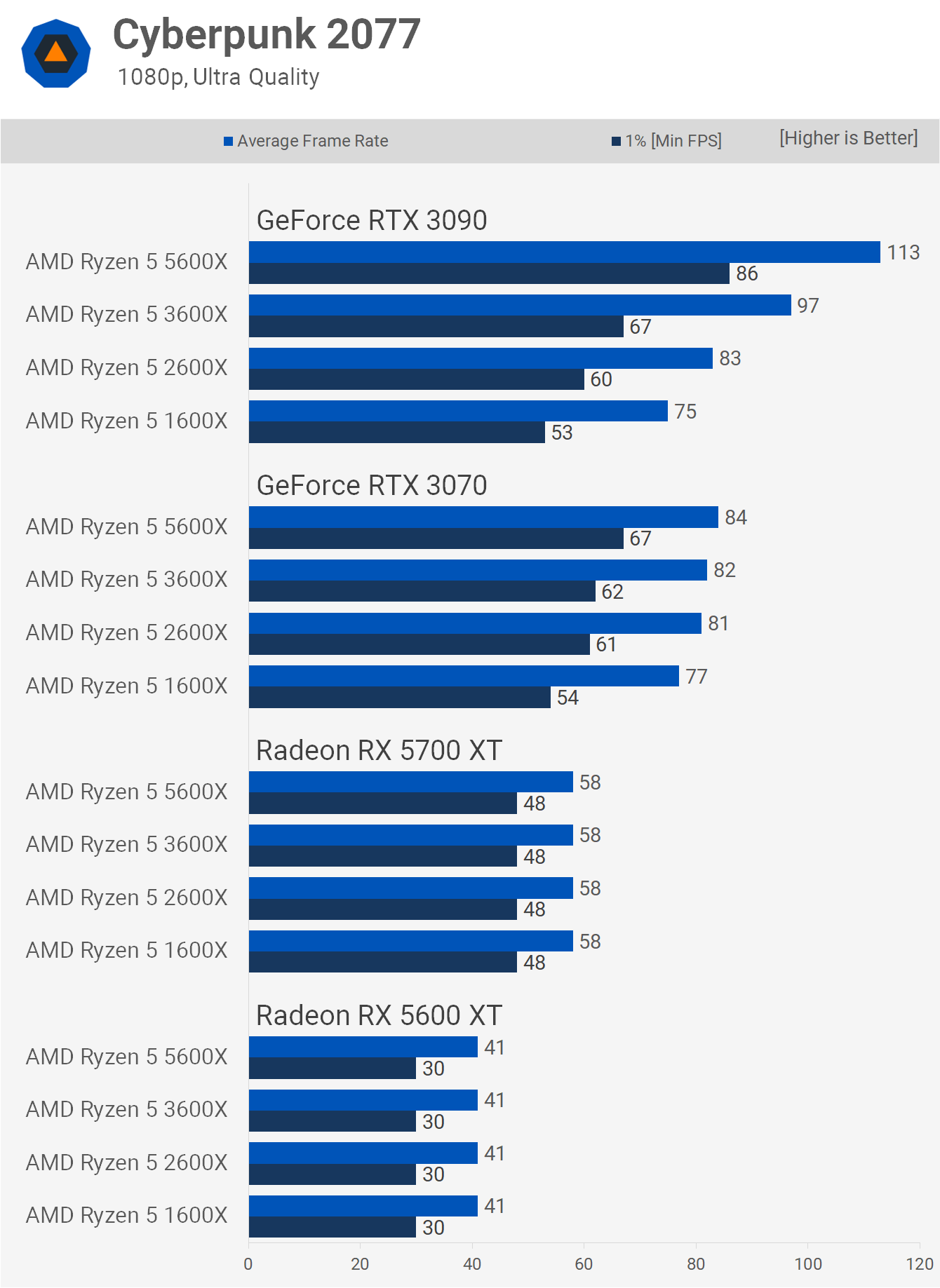
Stepping upward to the RTX 3070, nosotros see the 5600 XT outperform the 3600X past an eight% margin when comparison i% low data, 10% faster than the 2600X and 24% faster than the 1600X. Those margins only increase with the RTX 3090, the 5600X is now 28% faster than the 5600X when comparison the 1% low results, 43% faster than the 2600X and a massive 62% faster than the 1600X which limited average frame charge per unit performance to around 75 fps.
You might have noticed the 1600X was a frame or two faster with the 3070 when compared to the 3090, and while that'southward typically accounted to be within margin of error, you're going to see there might be more to this.
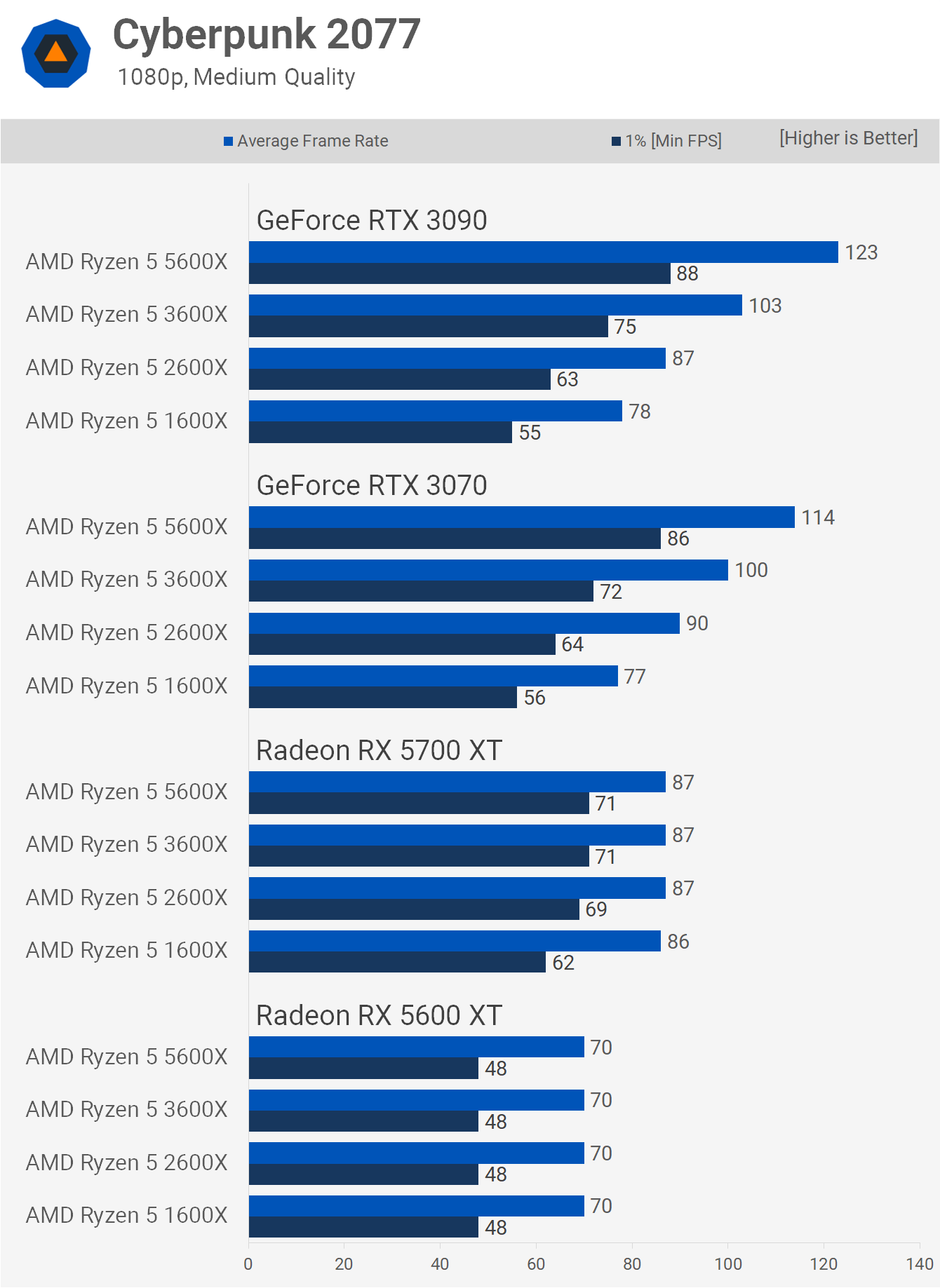
By lowering the quality preset we're allowing the GPUs to render more than frames which does increase CPU load, though you tin also reduce the CPU workload as there's less information in each frame to calculate, so it'south a unlike kind of load. Every bit a result of the higher frame rate, the 1600X slips backside with the 5700 XT, at to the lowest degree when comparing i% low functioning, though this wasn't the case with the 5600 XT.
We also detect that the game is now largely CPU bound using the Ampere GPUs as the RTX 3070 and 3090 performance is very like. Using the 3090 we run across that the 5600X is xix% faster than the 3600X, 41% faster than the 2600X and 58% faster than the 1600X, so some rather larger performance gains at that place over previous generation Ryzen architectures.
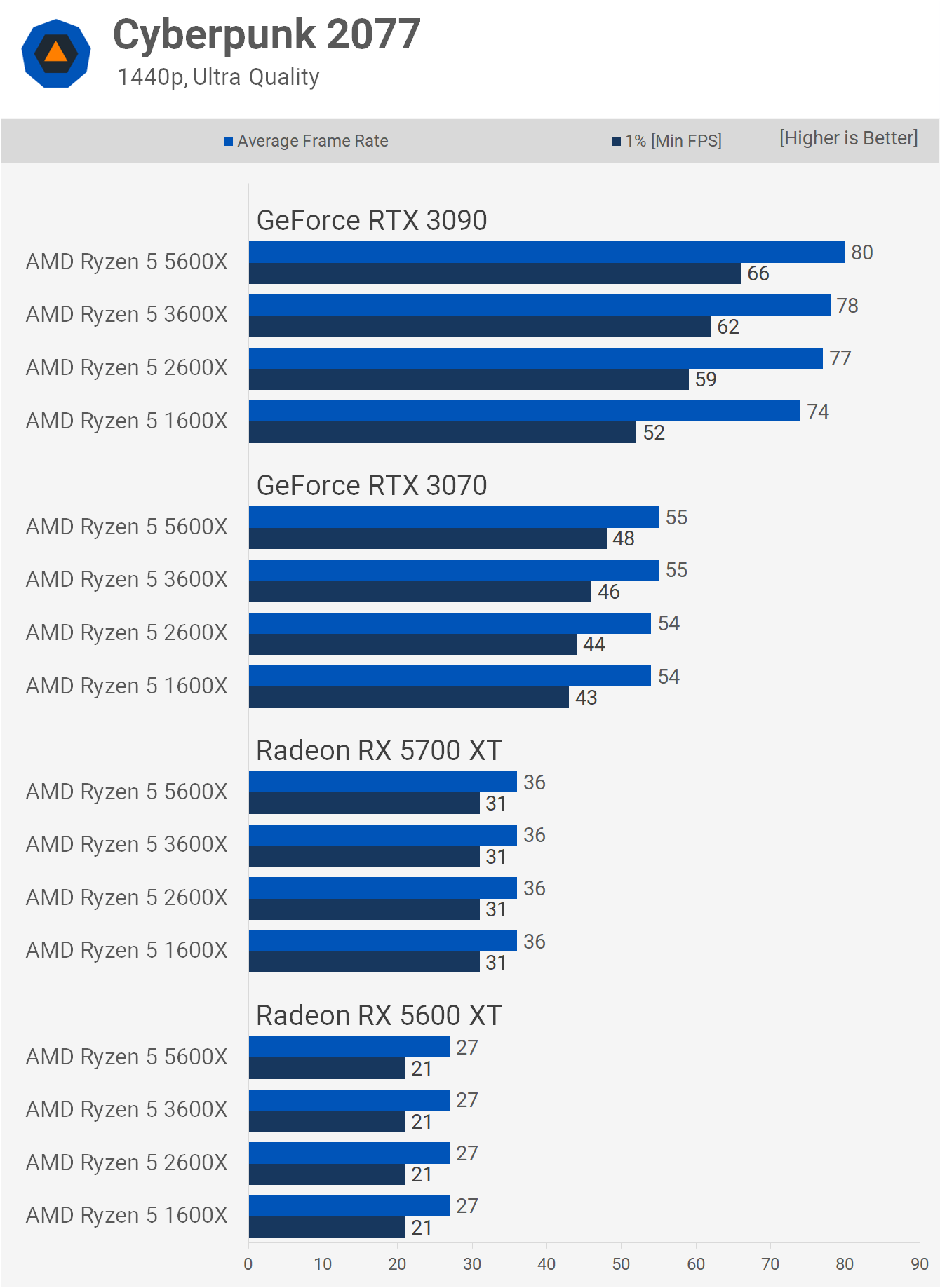
Now jumping up to 1440p which increases the GPU load more than it does CPU load sees the game go primarily GPU limited, at least when using an RTX 3070 or slower. Looking at the 1% low data we see that the 5600X is up to 12% faster than the 1600X when using the RTX 3070, not a huge difference when compared to 1st gen Ryzen, but there's still a deviation here, non something we saw with the 5700 XT.
And so once we jump up to the RTX 3090 we come across up to a 27% operation difference between the fastest and slowest 6-core/12-thread Ryzen CPUs tested, though at that place was just an 8% divergence when comparing the average frame rate.
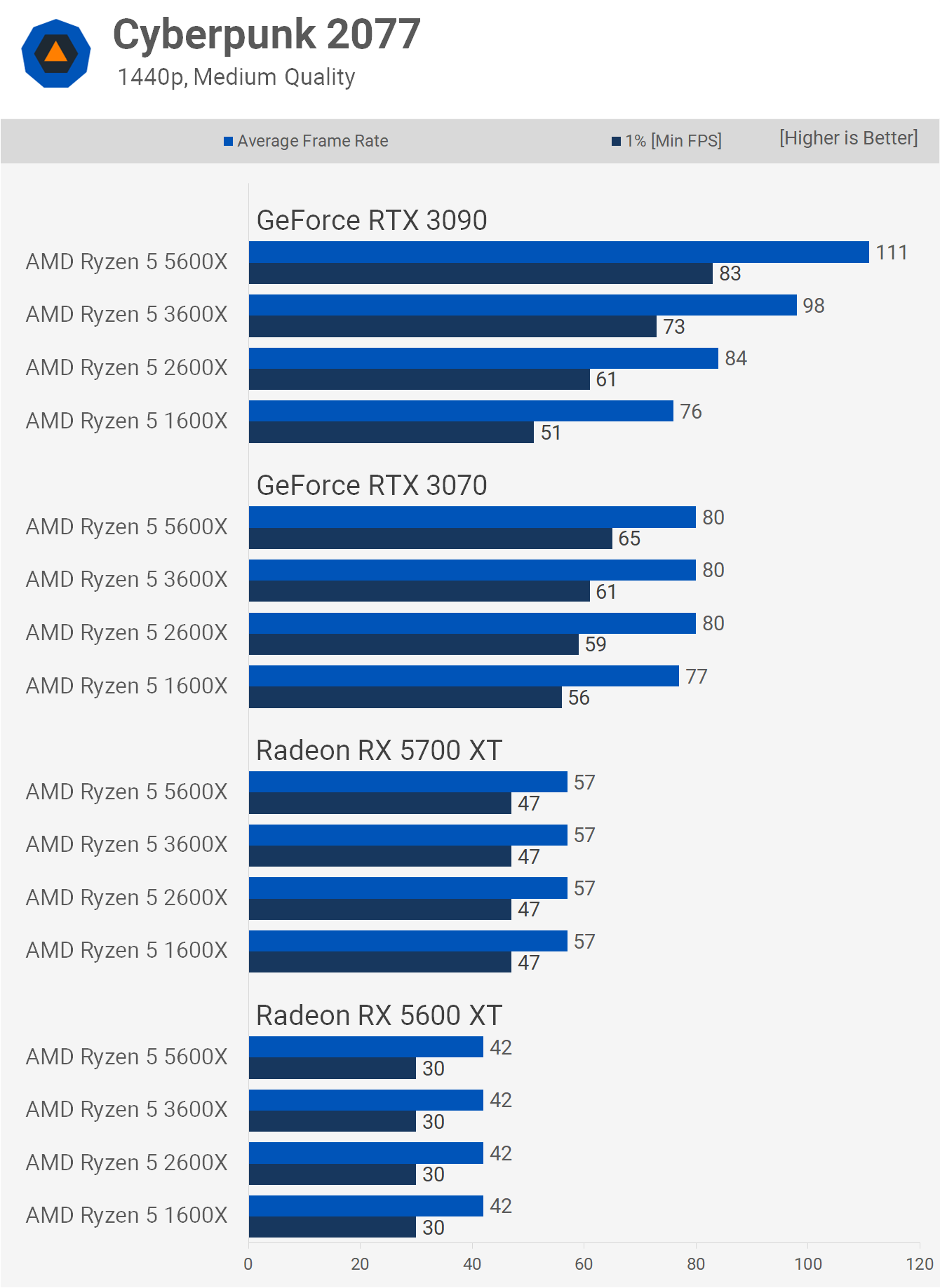
Now using the medium quality present at 1440p sees some variation in the ane% low performance when using the RTX 3070, here the 5600X was 7% faster than the 3600X, x% faster than the 2600X and 16% faster than the 1600X.
The margins only become noteworthy when using the RTX 3090, here the 5600X was upwardly to 14% faster than the 3600X, 36% faster than the 2600X and 63% faster than the 1600X which is obviously a massive margin, though it volition crave extreme GPU horsepower for that divergence to be realized.
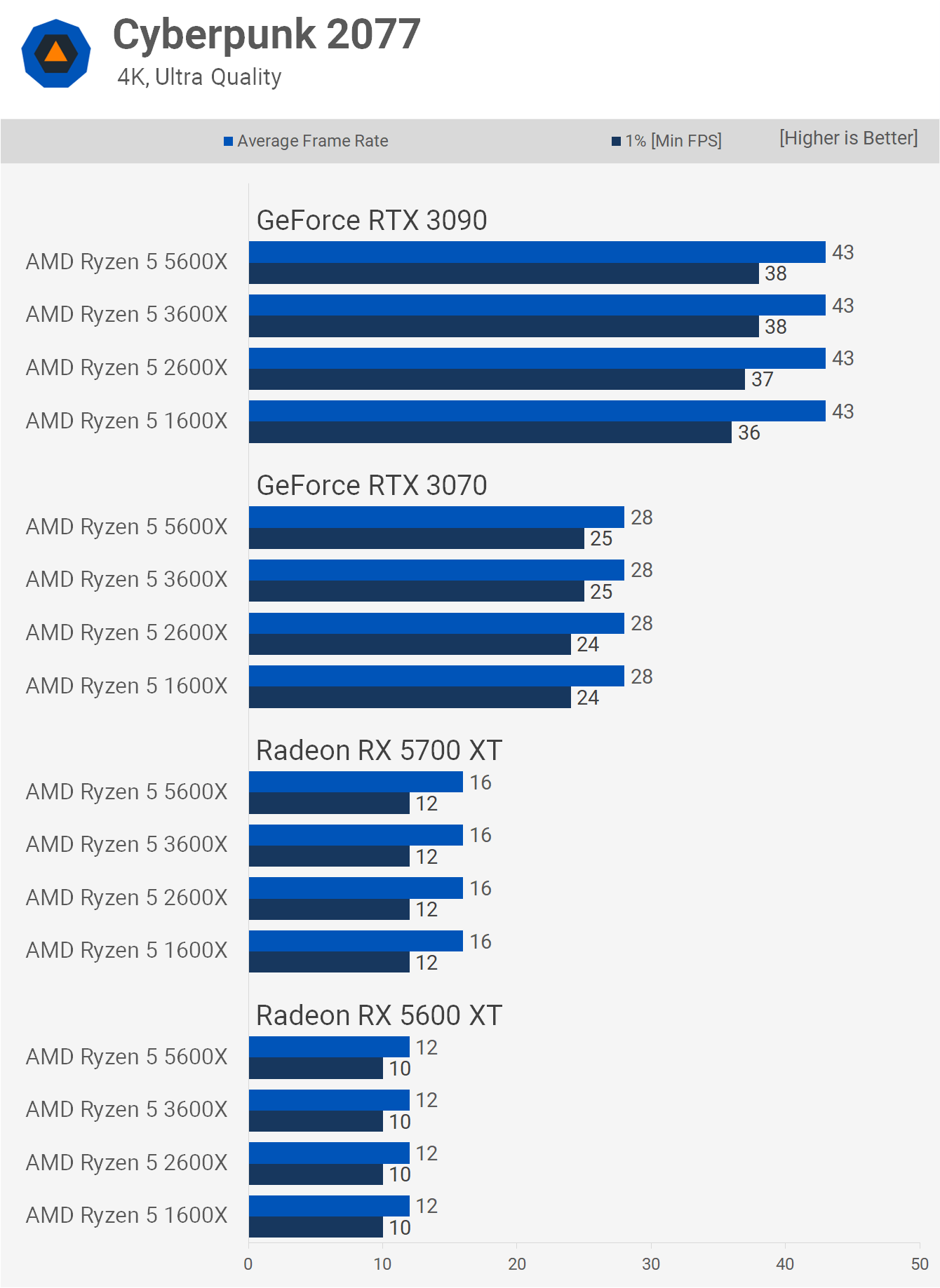
Climbing up to 4K virtually eliminates performance margins, even when using the RTX 3090, the 5600X was just up to viii% faster than the 1600X, that was a 2 fps deviation while the boilerplate frame charge per unit was identical.
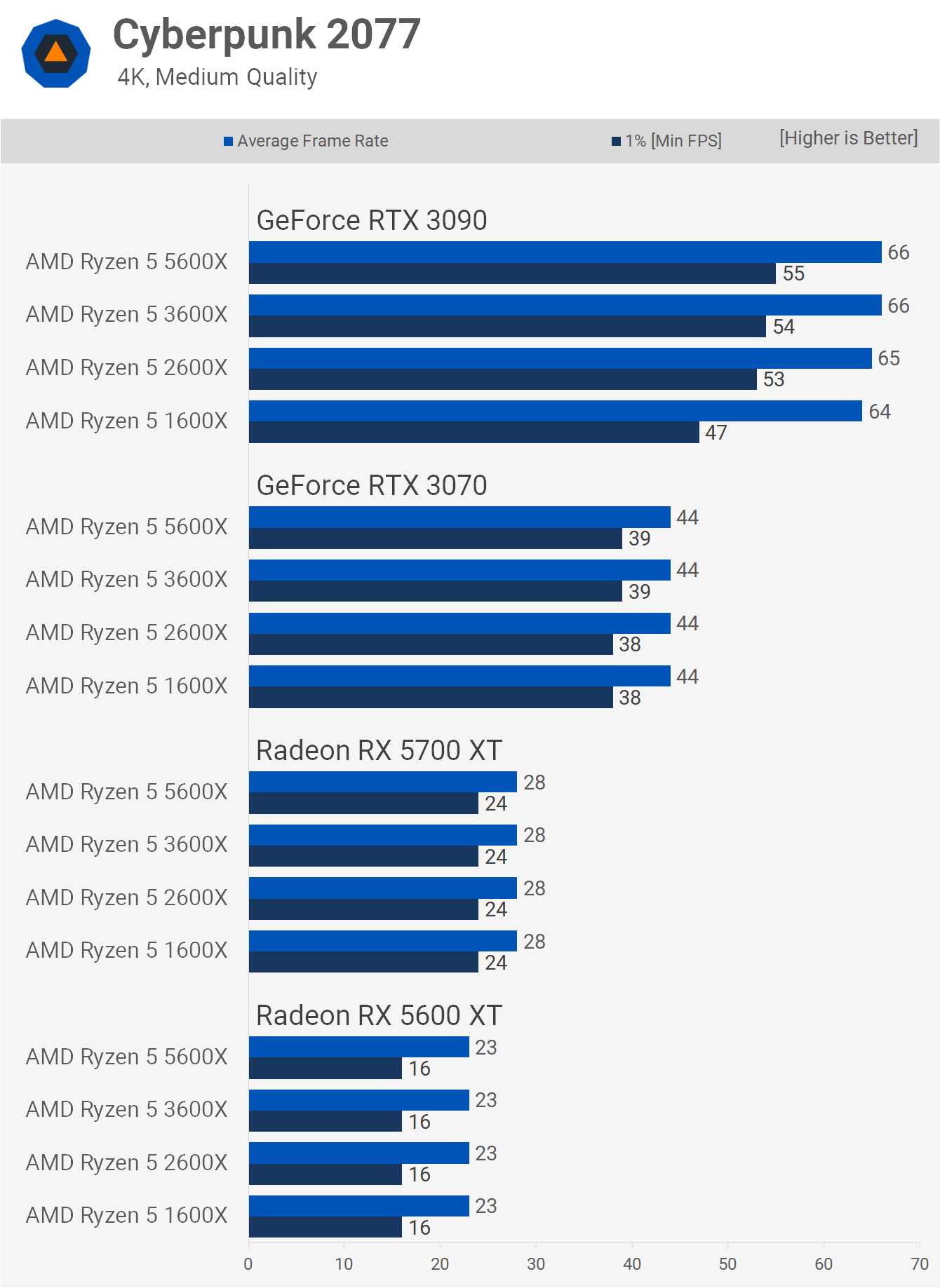
Using the medium quality settings at 4K sees all four CPUs deliver the exact same performance using the RTX 3070, 5700 XT and 5600 XT.
The 1600X does suffer a little with the RTX 3090 and here the 5600X was 17% faster when comparison the one% low data.
Rainbow Six Siege
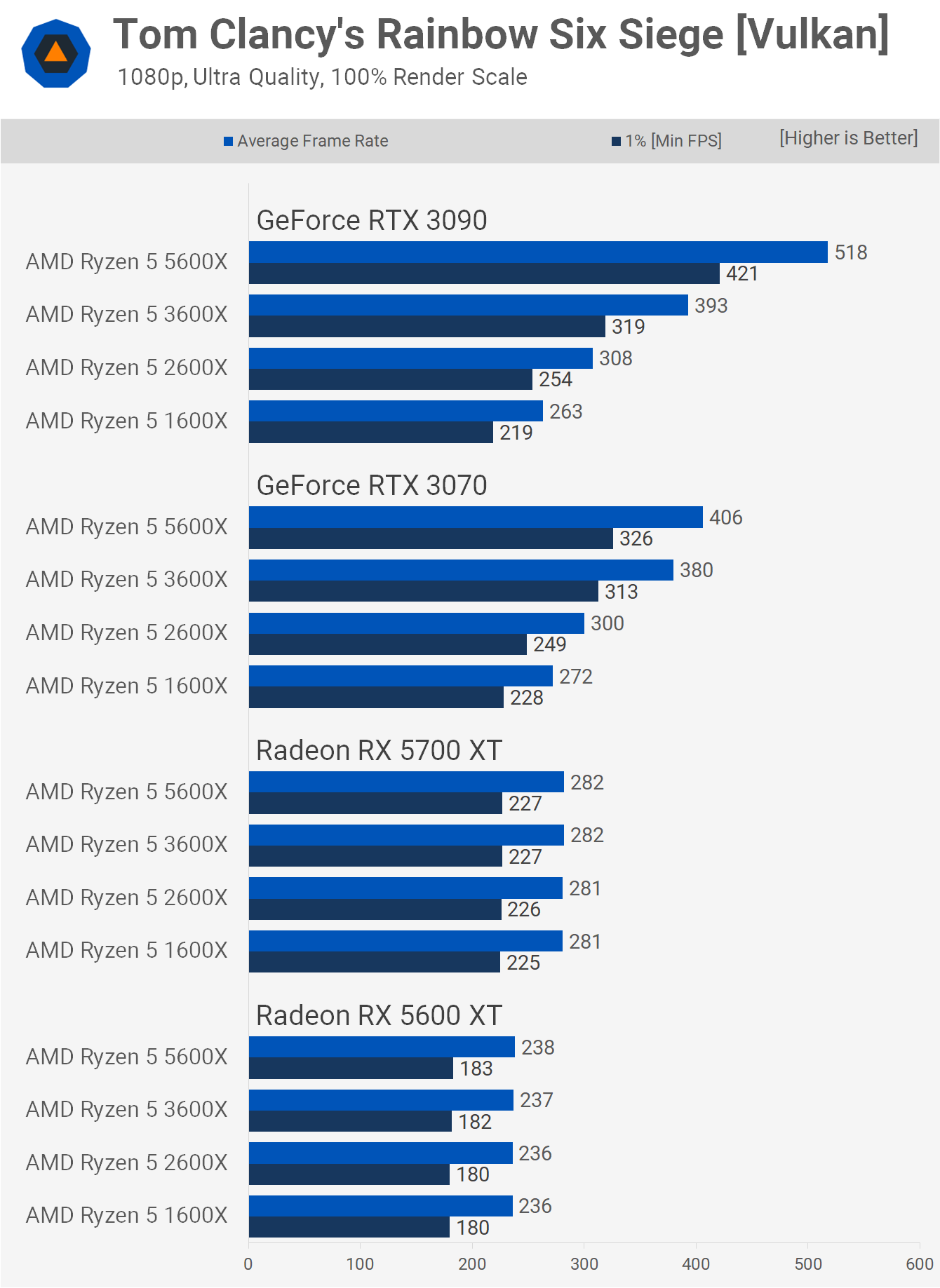
Moving on to Rainbow Six Siege and this is where things start to get rather complicated. At 1080p using the ultra quality preset the results using the 5600 XT and 5700 XT are pretty much as y'all'd expect, the game is heavily GPU jump here and even the old Ryzen five 1600X tin can max out these GPUs.
However, as we move to the Ampere GPUs a few foreign observations tin can be fabricated. Firstly, the Ryzen 5 1600X is slower using either the RTX 3070 or 3090 when compared to what we see with the 5700 XT. How is this possible you might exist asking? We believe it'south a two-pronged reply: the Nvidia drivers and the Ampere architecture.
Nvidia drivers have a high cadre dependency for multi-threading workloads, like what we see in DX12 and Vulkan titles. CPU architectures that feature a non-coherent cache similar what we meet with Zen, Zen+ and Zen iii will demand to exist optimized for. Nosotros believe the issue is less pronounced with Zen+ due to enshroud optimizations that pb to the 2600X being faster overall, providing a less CPU-bound scenario.
Another oddity is that the Ryzen v 1600X was able to deliver a slightly higher frame charge per unit with the RTX 3070 when compared to the 3090. We're only talking about a 3% increase, but it was repeatable. We're guessing at this point merely we believe the wider design of the GA102 die is creating more than CPU load as the commuter scheduler works harder to feed all those extra cores. We'll need to test more hardware configurations to work out what'southward going on here.
Any the case, it'due south fascinating to find that the Ryzen 5 1600X is able to deliver 7% more frames with the 5700 XT when compared to the RTX 3090. As for the RTX 3090 results, the 5600X was 32% faster than the 3600X, 68% faster than the 2600X, and an insane 97% faster than the 1600X, when comparing average frame rates.
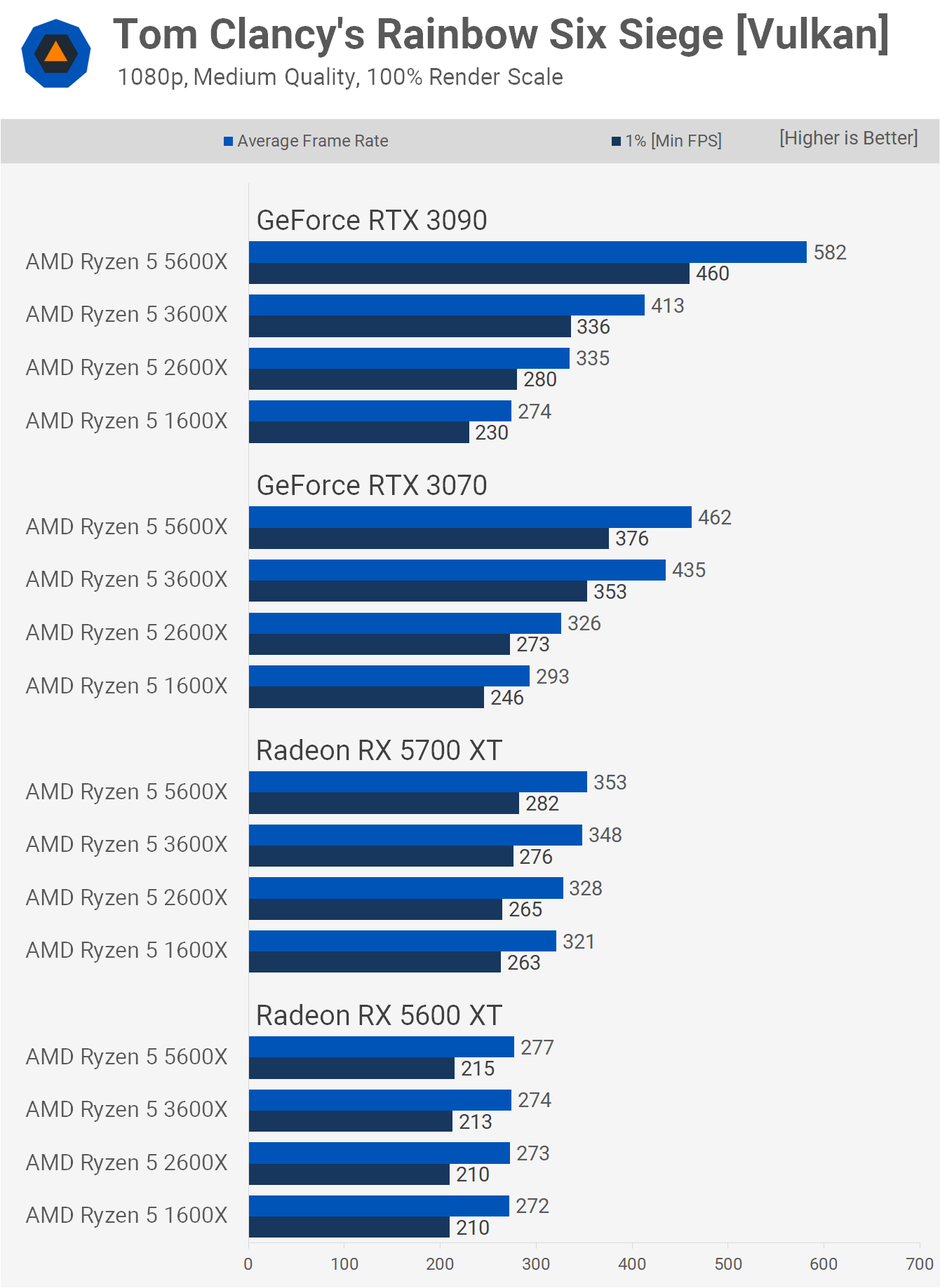
The funny results seen with Ampere GPUs using the ultra loftier preset are even more pronounced with the medium setting. If nosotros look at the Ryzen v 1600, we run across that this CPU was able to roughly max out the Radeon 5600 XT with 272 fps on average and that figure was boosted by 18% with the 5700 XT to 321 fps.
However, by using what is technically a faster GPU with the RTX 3070 we find that the 1600X operation declines past 9% to 293 fps and then a further 6% with the RTX 3090 to 274 fps, or the aforementioned level of performance seen with the 5600 XT. This issue is less severe with the faster 2600X, but we still encounter a situation where going from the 5700 XT to the RTX 3090 does lilliputian to amend performance.
This effect is largely solved with the 3600X which saw a 25% performance increase when jumping up from the 5700 XT to the RTX 3070. Yet in one case over again nosotros find that the higher core-count RTX 3090 slowed down the 3600X by a five% margin, dropping the boilerplate frame charge per unit from 435 fps to 413 fps when naturally yous'd expect the reverse.
The just CPU that scales correctly here is the 5600X and its unified L3 cache. Nosotros meet a 26% performance heave when moving from the 3070 to the 3090, and a 65% increase from the 5700 XT.
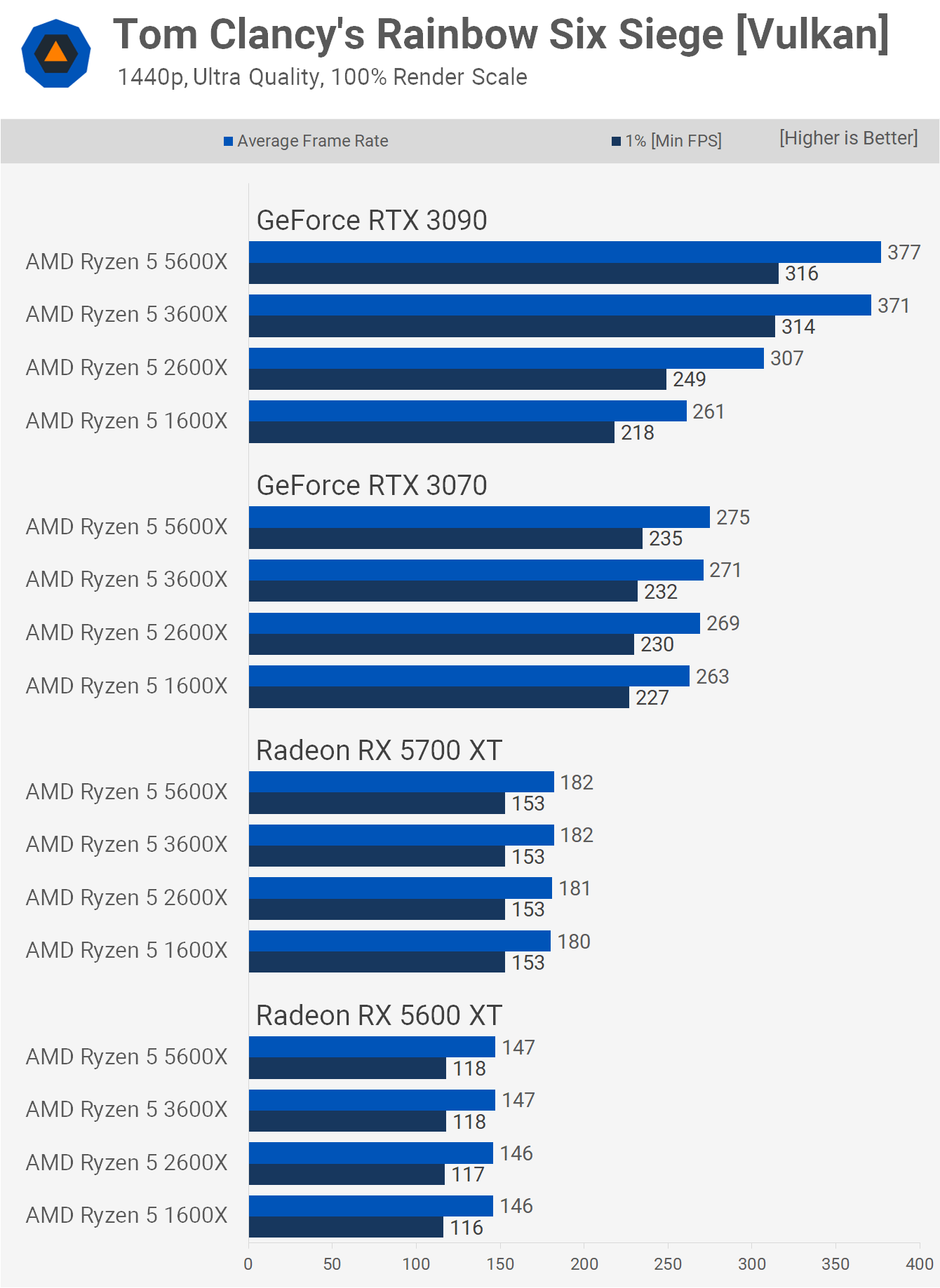
By drastically increasing the GPU load at the 1440p resolution, we observe that scaling returns to normal. Here we're observing similar CPU performance beyond the board when using the RTX 3070 or slower. The R5 1600X did drop some when upgrading to the RTX 3090, though that wasn't the case for the 2600X which saw a 14% increment.
The 5600X and 3600X were both fast enough to max out the RTX 3090 and that meant the new Zen three processor was 23% faster than the 2600X and 44% faster than the 1600X.
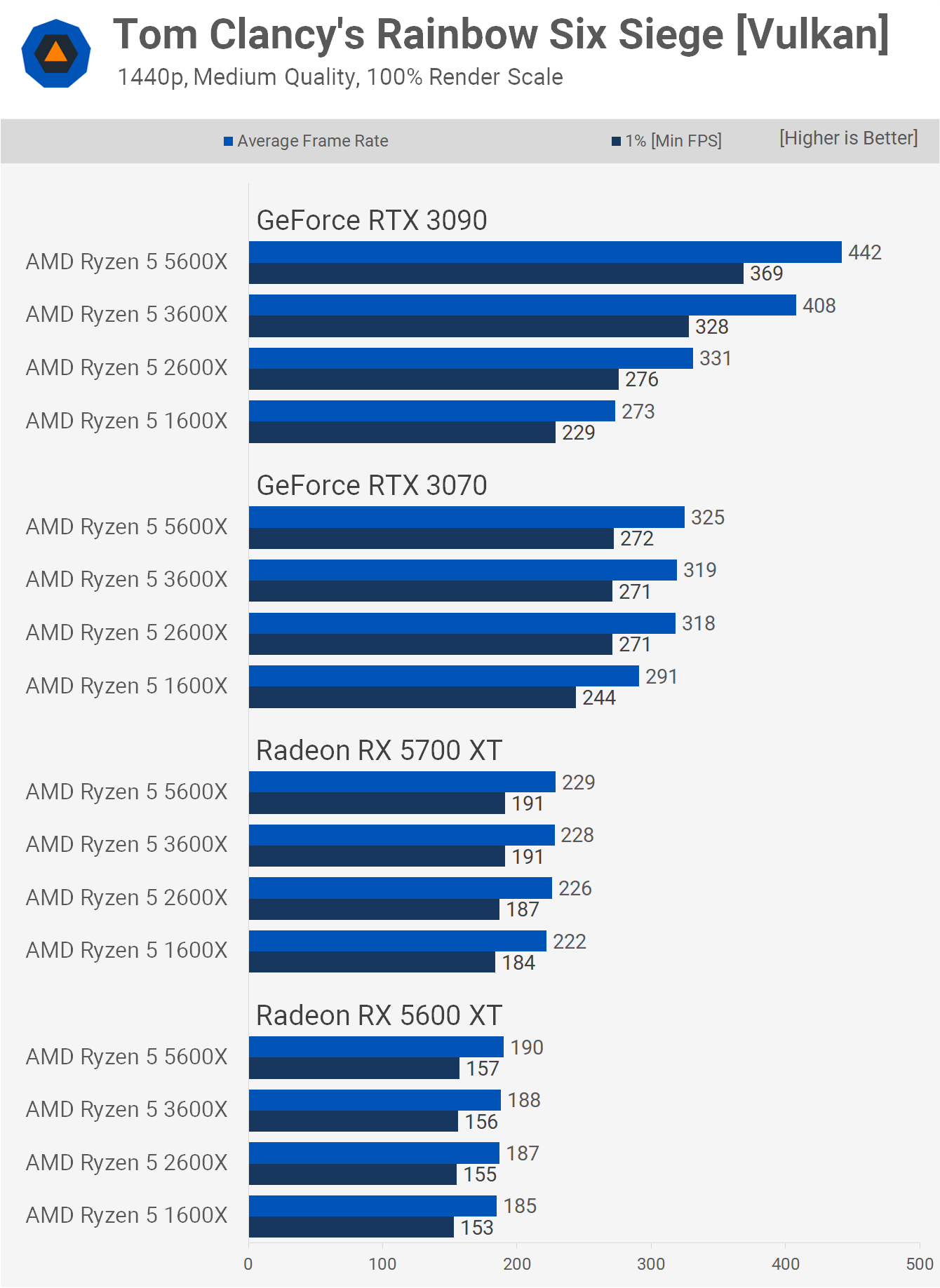
Lowering the quality to medium at 1440p sees the 1600X trail the newer Zen parts and this just goes to evidence how significant the refinements made with the Zen+ architecture really were.
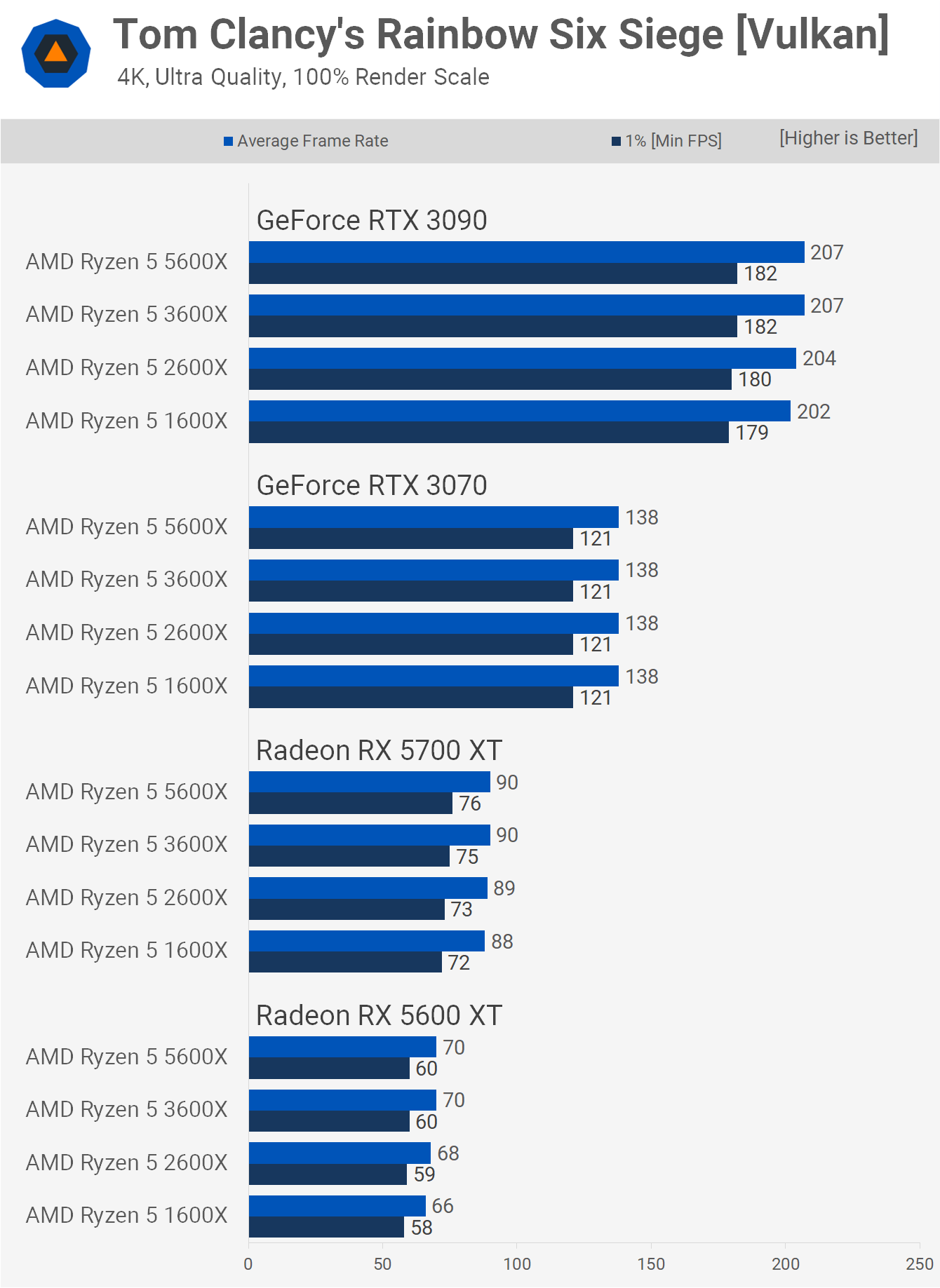
Once nosotros attain 4K, at that place's little to see in the way of performance differences, basically we're heavily GPU limited and even the 1600X comes close to maxing out every GPU.
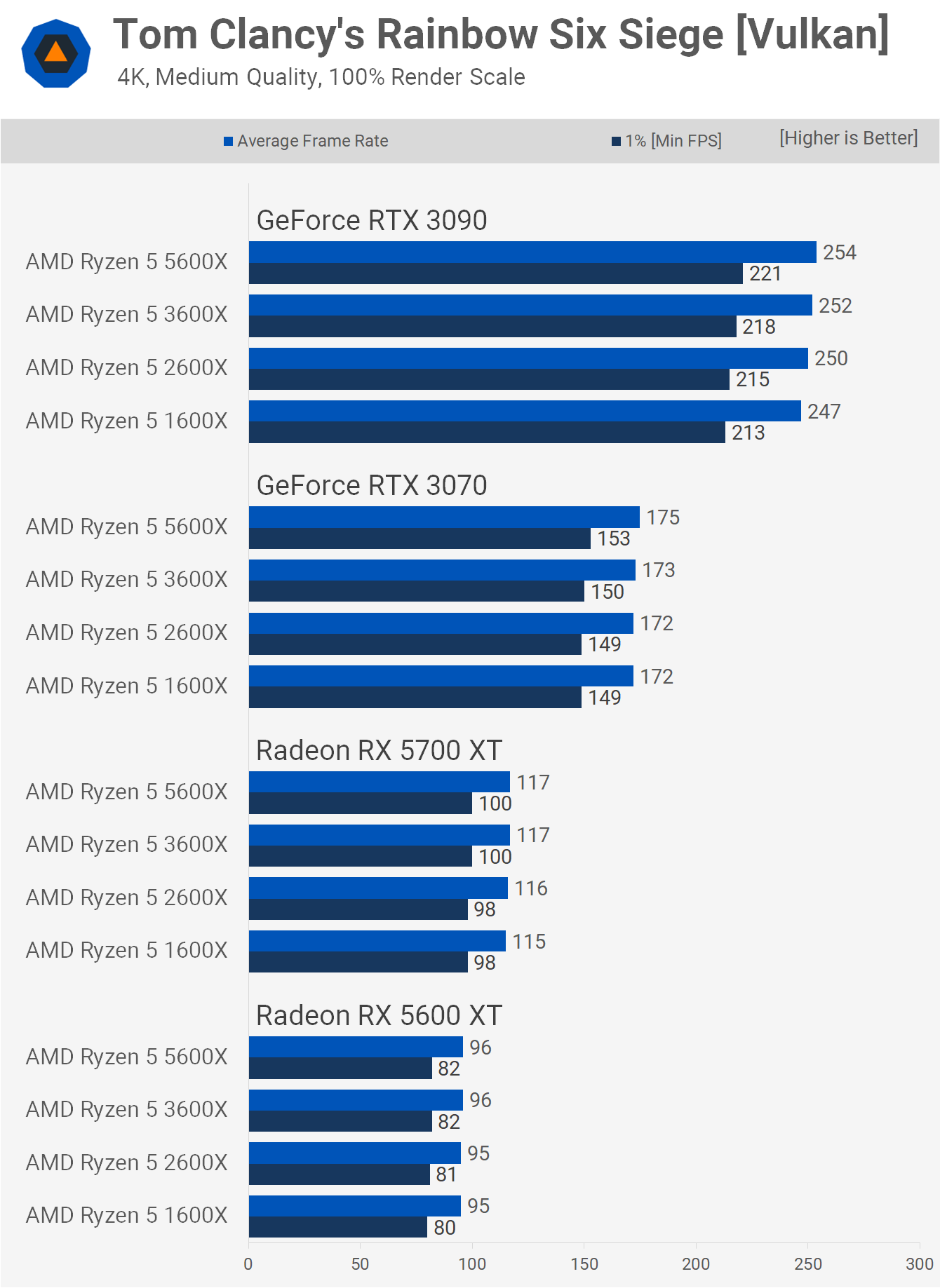
Nosotros see much of the same with the medium quality settings at 4K.
Horizon Naught Dawn
Time for more odd results in Horizon Aught Dawn when looking at 1080p ultra quality information. The Radeon results are what you'd wait to find, all 4 CPUs maxed out the 5600 XT, while nosotros see a small operation comeback for the 3600X and 5600X using the 5700 XT.
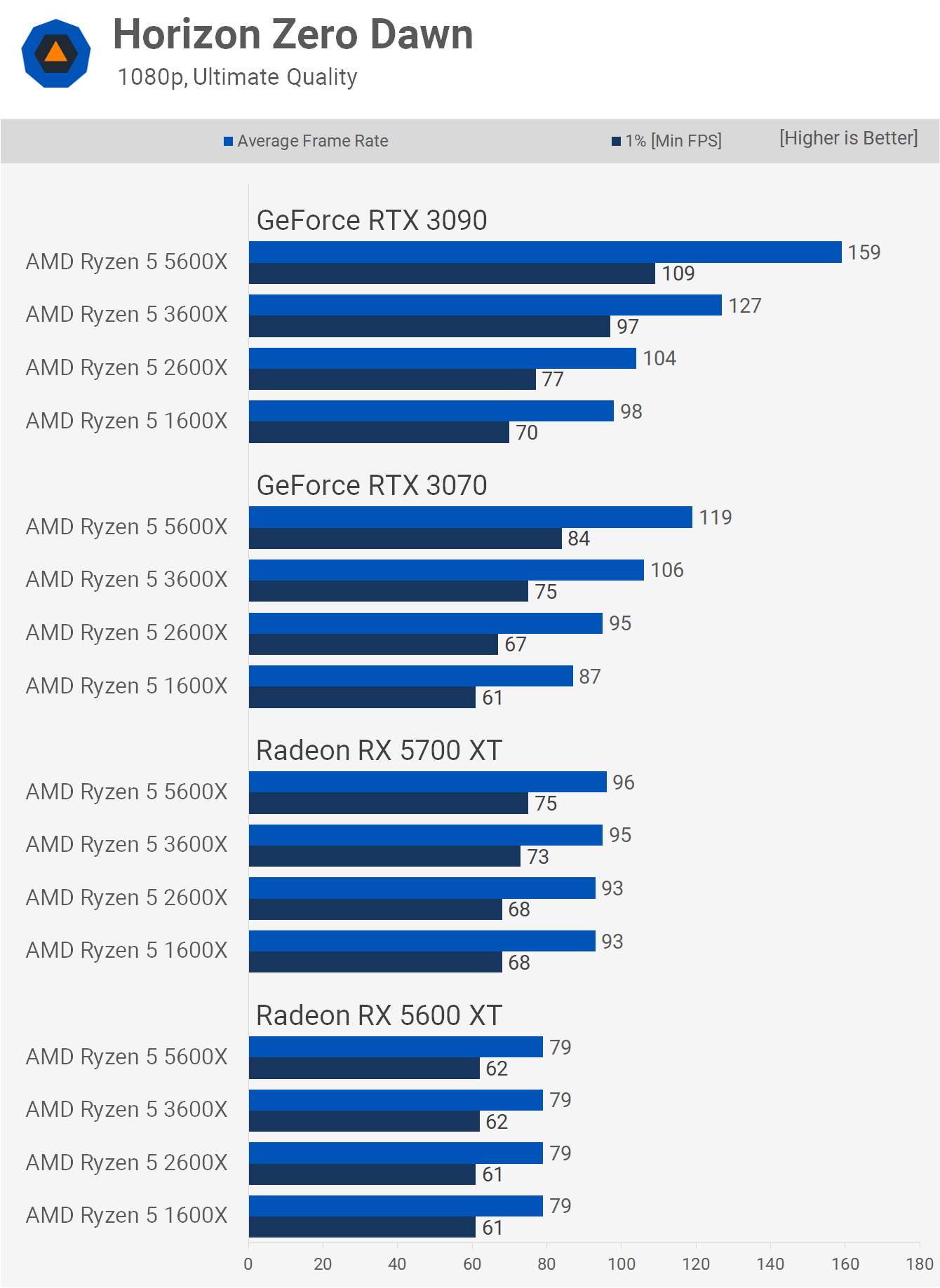
Even so, information technology's once more the 1600X results using Ampere GPUs that are confusing relative to what we saw with the 5700 XT. Whereas the 1600X averaged 93 fps using the 5700 XT, it was skilful for just 87 fps with what should be the faster RTX 3070, though it did peak at 98 fps using the RTX 3090.
The 2600X on the other hand was fast enough to mitigate the overhead with the Ampere GPUs, delivering virtually the same functioning with the 5700 XT and RTX 3070 to run into a 12% uplift with the RTX 3090.
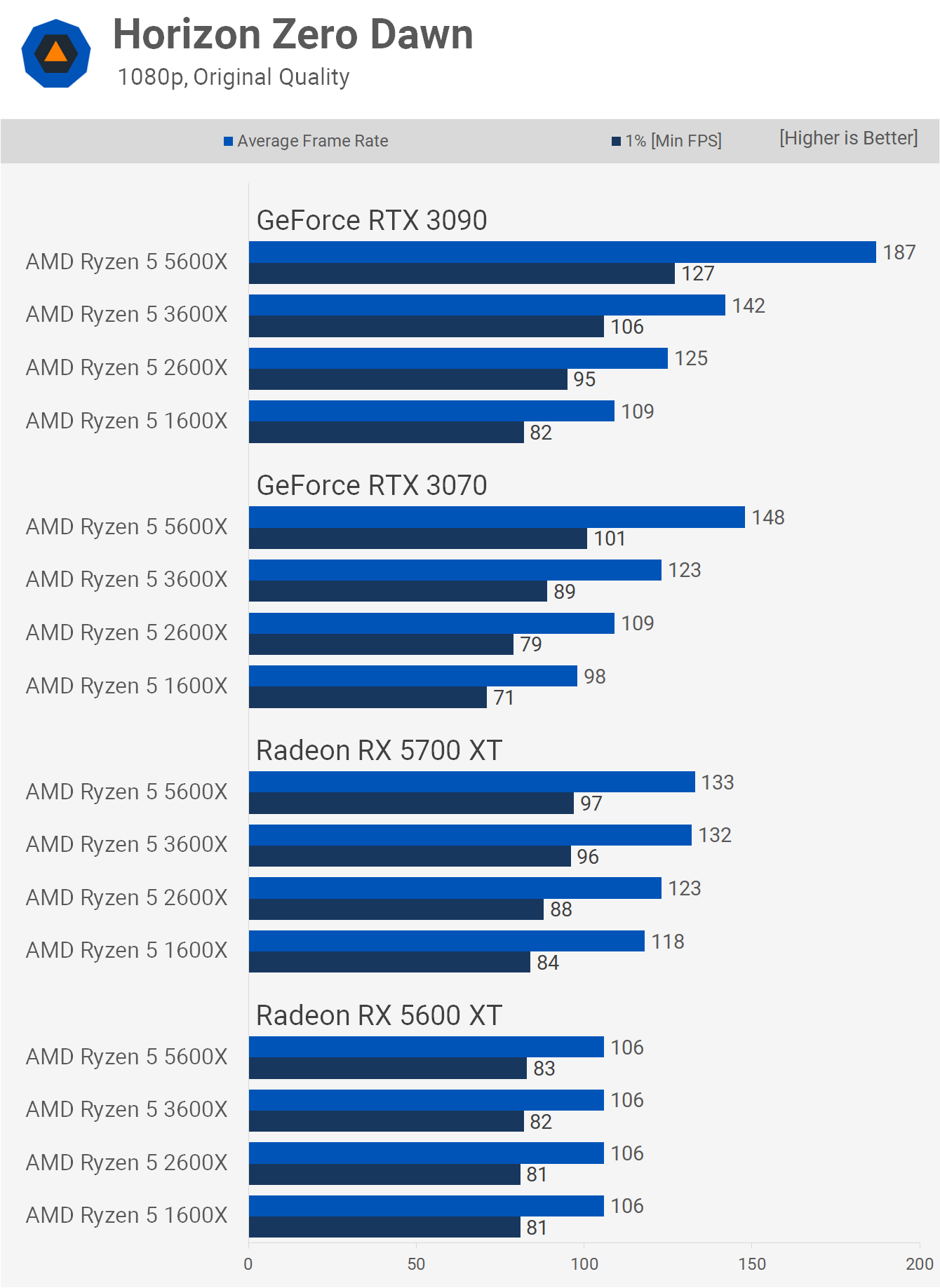
The 1080p results are more farthermost using the medium quality preset. Hither we're seeing a bigger performance difference between the 1600X and 2600X when compared to the 3600X and 5600 XT using the 5700 XT, just that'due south not the most interesting matter to note.
The Ryzen 5 1600X results are truly bizarre as this CPU was proficient for 118 fps on boilerplate with the 5700 XT, withal just 98 fps with the RTX 3070 and 109 fps with the RTX 3090. A similar matter is seen when using the 2600X, it was good for 123 fps with the 5700 XT but only 109 fps with the 3070, though it did jump back up to 125 fps with the 3090. In fact, even the 3600X was faster with the 5700 XT when compared to the RTX 3070, though information technology was viii% faster with the 3090.
Looking at those results you'd think that the 5700 XT was the superior performer, but technically it'due south not as the 5600X was a massive 40% faster using the flagship Ampere GPU. Now if nosotros wait at the CPU limited RTX 3090 results we meet that the 5600X was 32% faster than the 3600X, 50% faster than the 2600X and 72% faster than the 1600X.
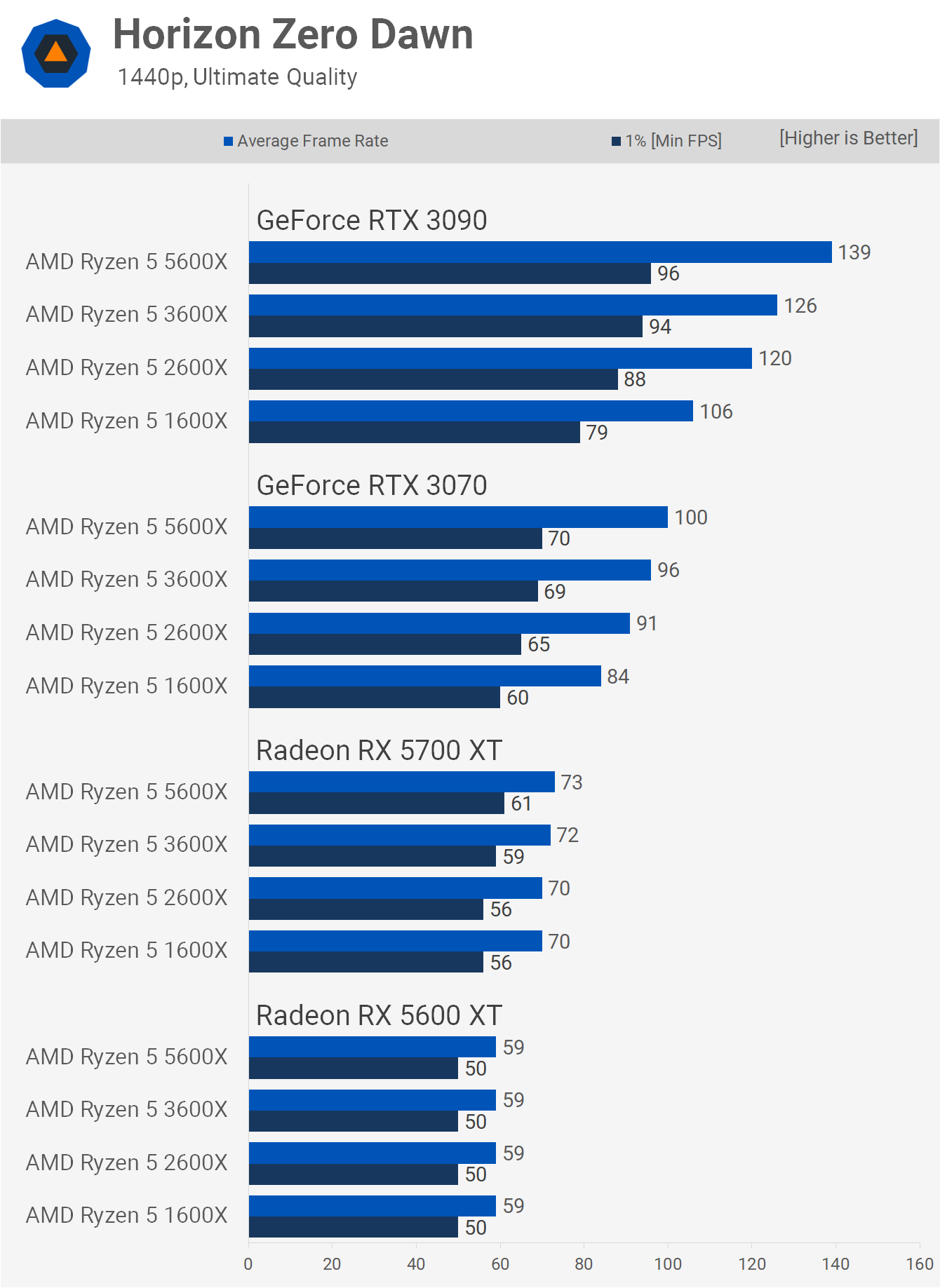
Once again nosotros find that increasing the resolution to 1440p which makes the exam more than GPU leap, sees the strange results between the RDNA and Ampere GPUs with the older Ryzen processors disappear. All plant CPUs maxed out the 5600 XT with but small-scale performance differences seen with the 5700 XT. Then nosotros see a universal performance uplift when moving to the RTX 3070 with farther gains for all processors seen with the RTX 3090.
Scaling with the RTX 3070 is adequately consistent, here the 5600X was 4% faster than the 3600X, ten% faster than the 2600X and 19% faster than the 1600X.
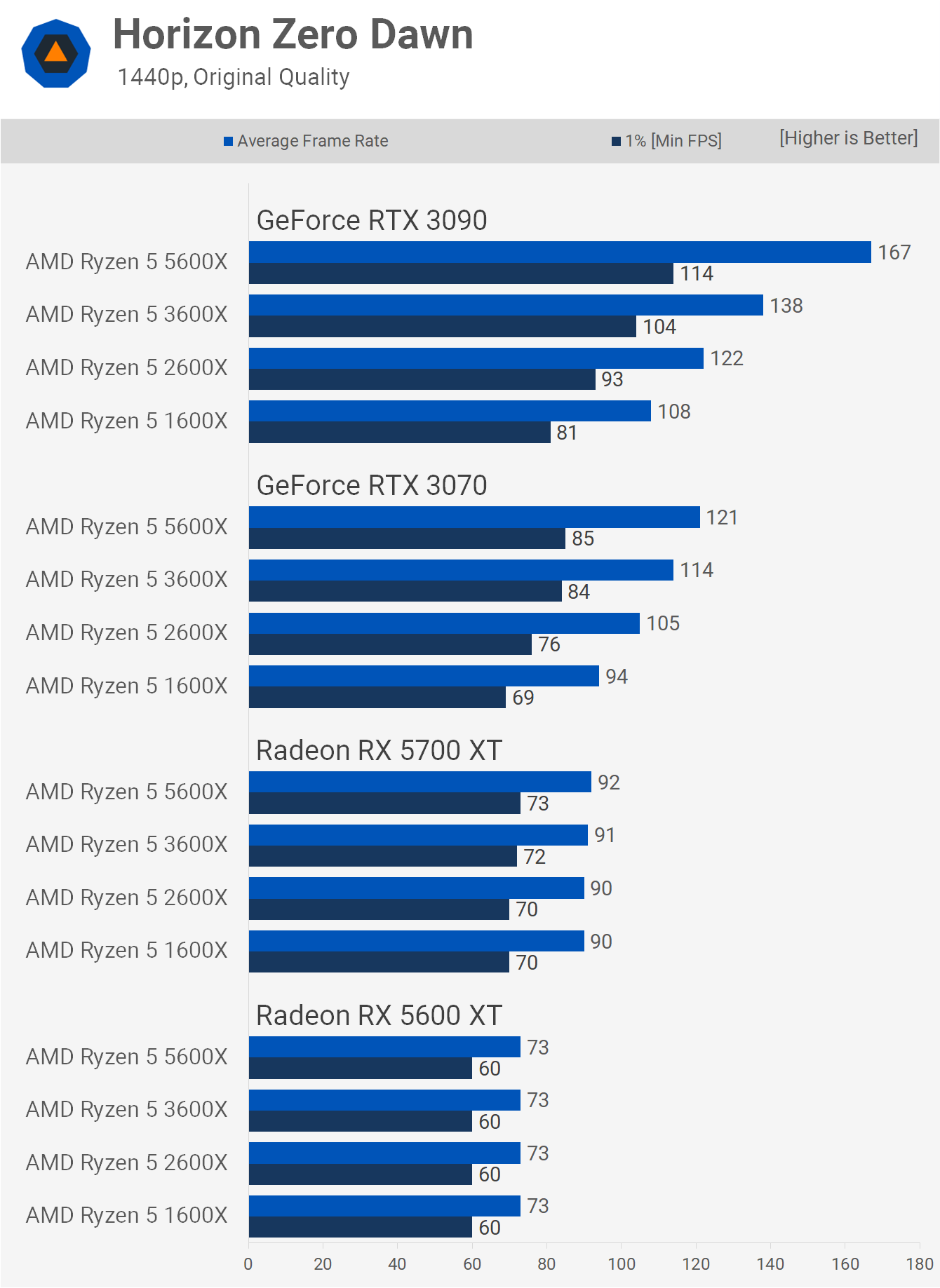
The 1440p medium quality margins are fairly similar to what we saw using the ultra preset, all four CPUs came close to maxing out the 5700 XT while we kickoff to see a noticeable difference in performance with the RTX 3070. Then by the time we reach the 3090 the 5600X is seen to exist delivering 21% more operation than the 3600X, 37% more than than the 2600X and 55% more than the 1600X.
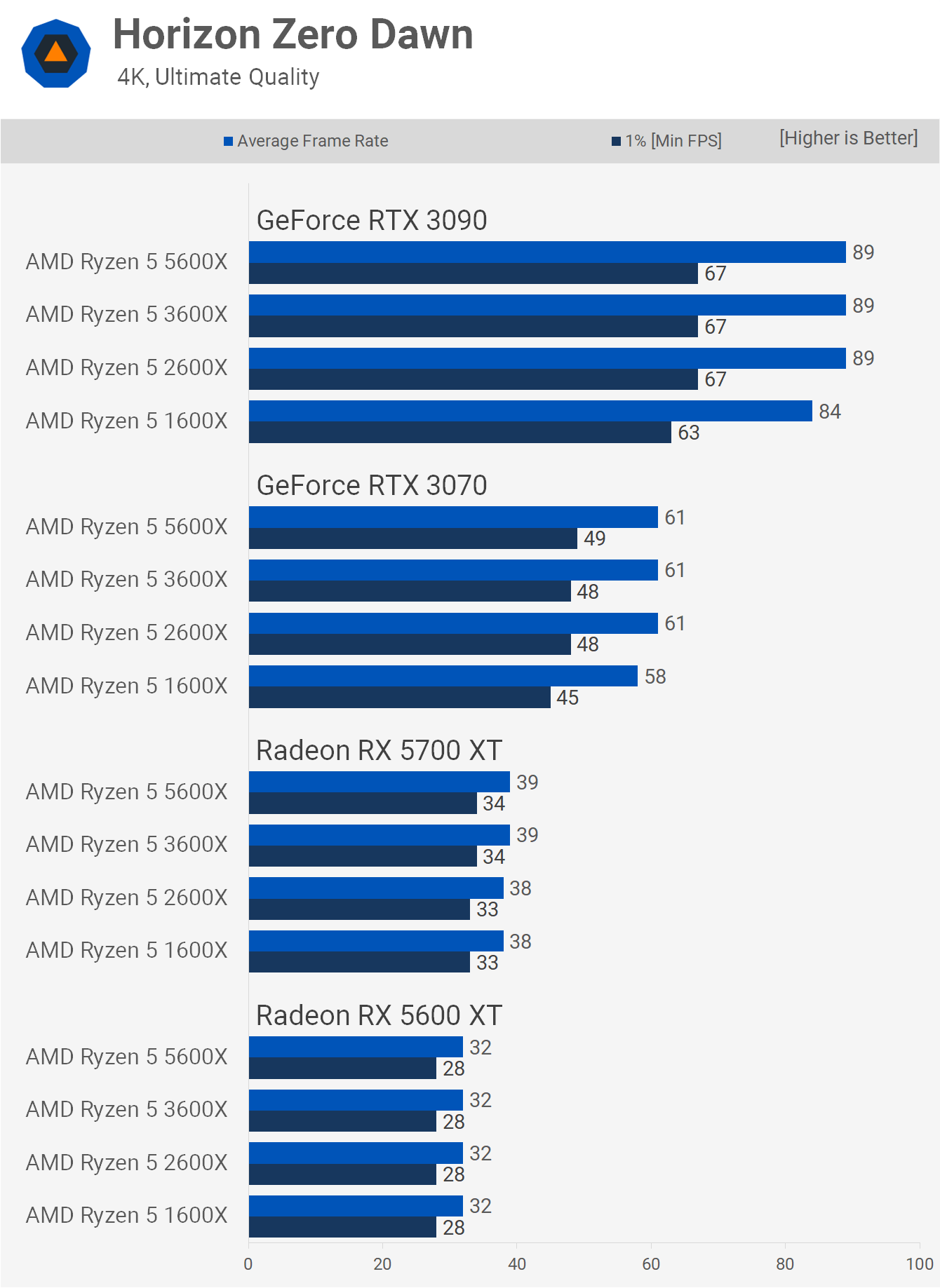
As expected, nosotros're almost entirely GPU jump at the 4K resolution. The 1600X trailed slightly with the Ampere GPUs but outside of that functioning was the same for the Zen+, Zen 2 and Zen 3 processors.
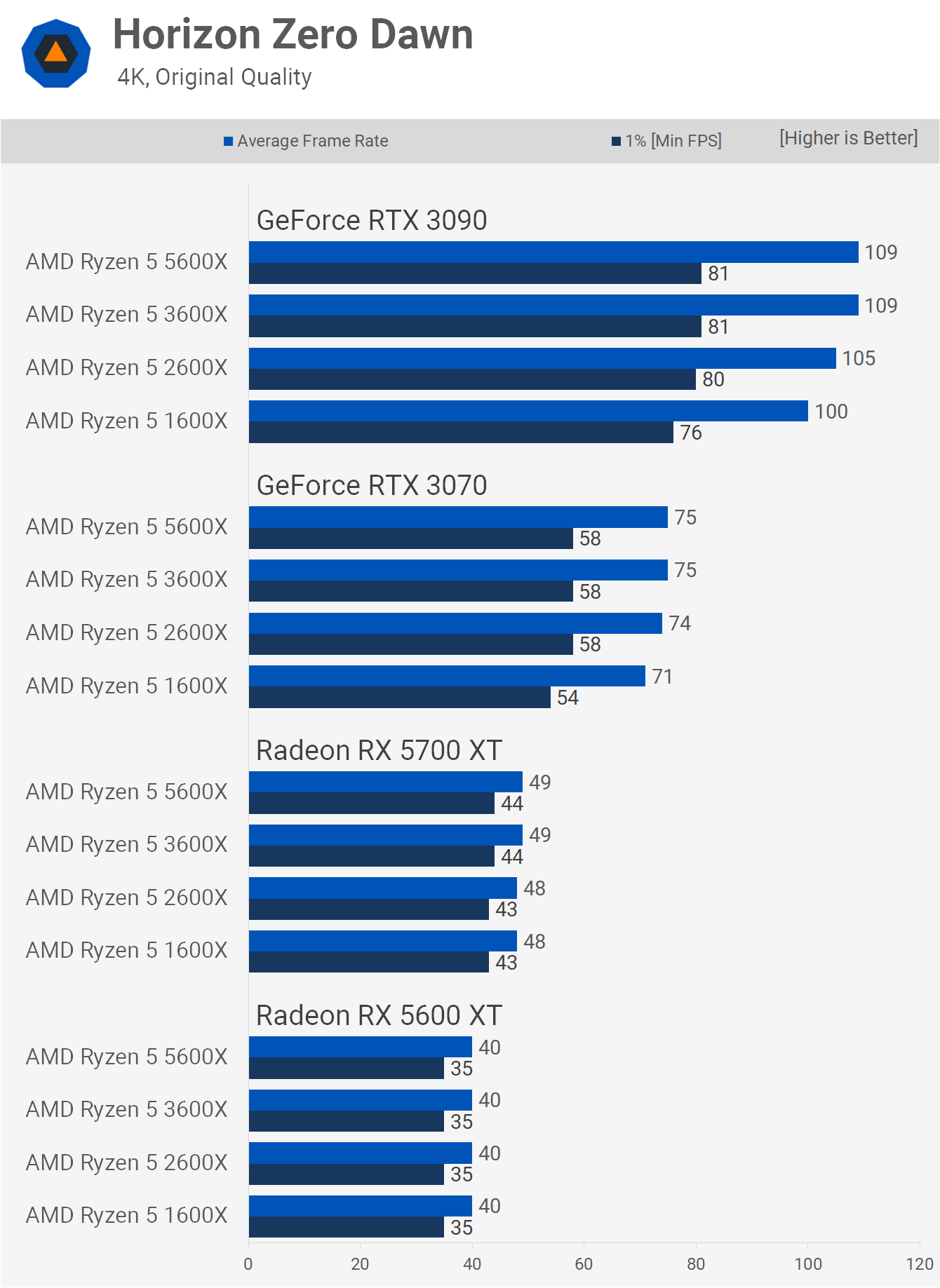
Using the medium quality settings at 4K saw some variation in the results using the RTX 3090, here the 3600X and 5600X were just four% faster than the 2600X and ix% faster than the 1600X.
Shadow of the Tomb Raider
Next up we have the very CPU enervating Shadow of the Tomb Raider and hither nosotros observe that fifty-fifty with the 5600 XT the Ryzen 5 1600X is dropping a few frames, particularly when looking at the one% depression performance. This is slightly more than pronounced with the 5700 XT where the 5600X was upwards to 17% faster.
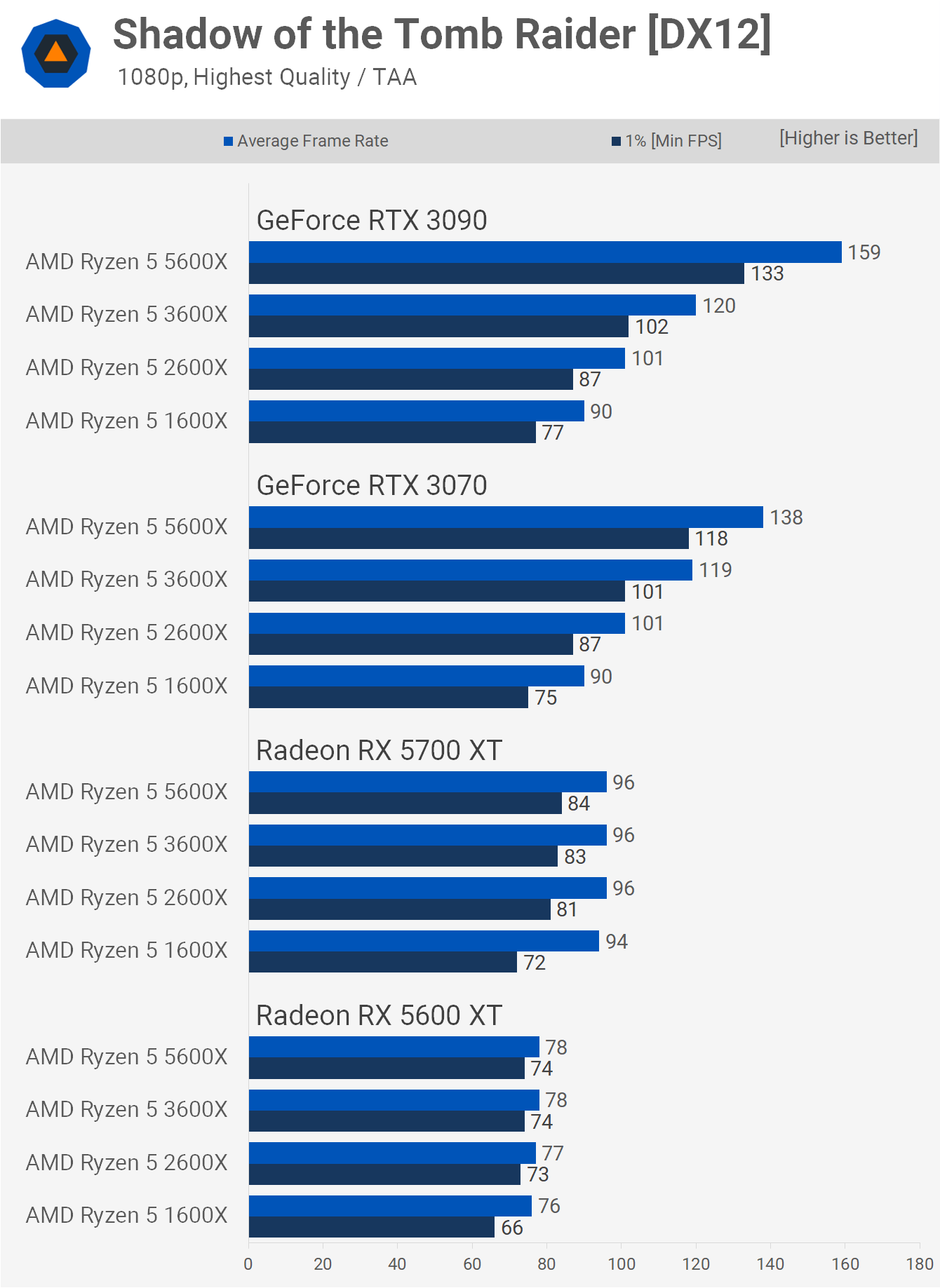
The 1600X saw a pocket-sized reduction in average frame rate performance with the Ampere GPUs, though there was besides a small uptick in 1% low performance. The 1600X, 2600X and 3600X all express the functioning of the 3090 and 3070 as the 5600X was xvi% faster than the 3600X when using the RTX 3070 and 33% faster with the RTX 3090.
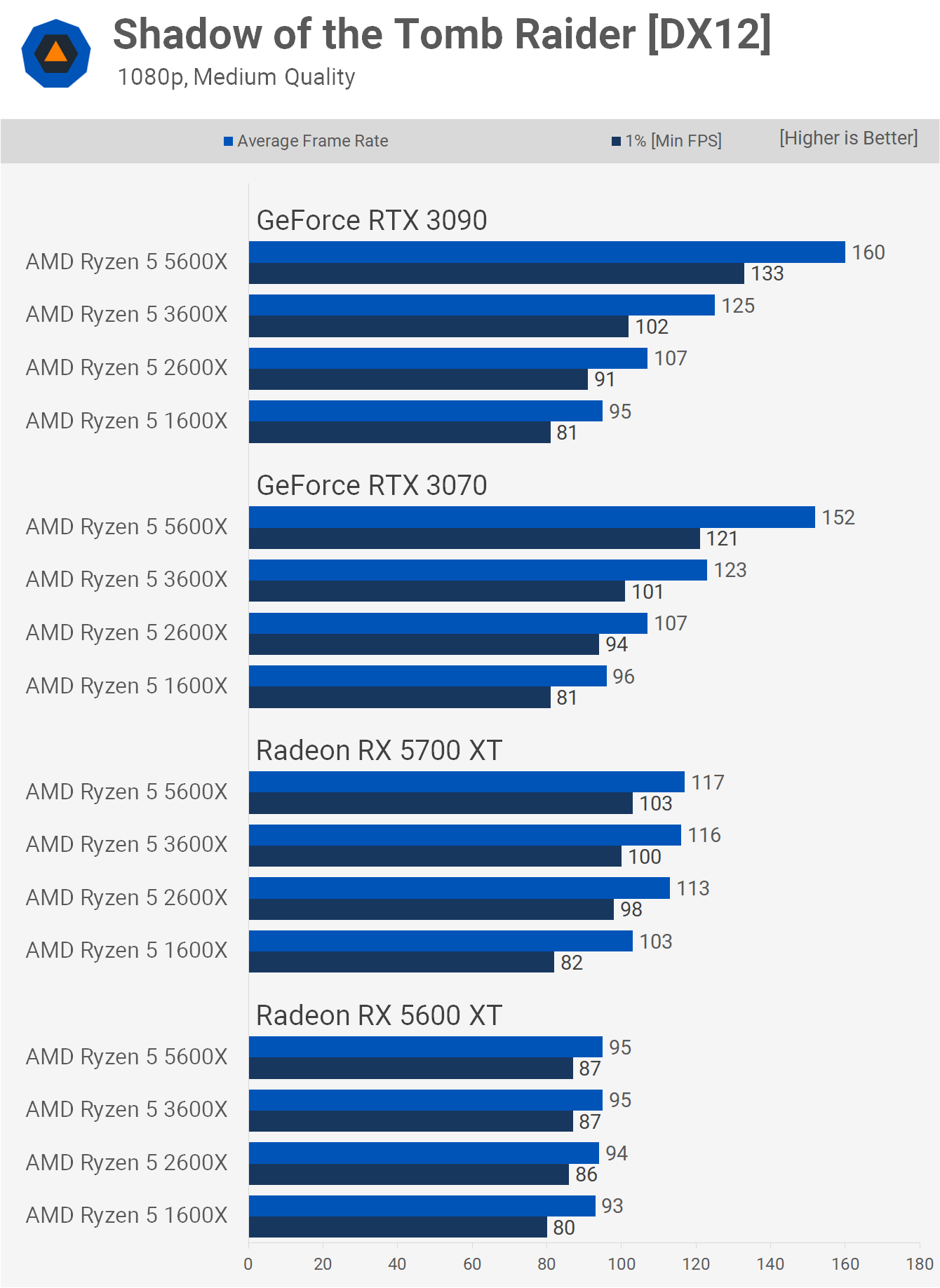
Using the medium quality settings at 1080p resulted in very similar operation margins and once more the 1600X was slightly faster using the 5700 XT when compared to the Ampere GPUs, the same was also true of the 2600X.
Then with the RTX 3090 nosotros run across that the 5600X was 28% faster than the 3600X, 50% faster than the 2600X and 68% faster than the 1600X.
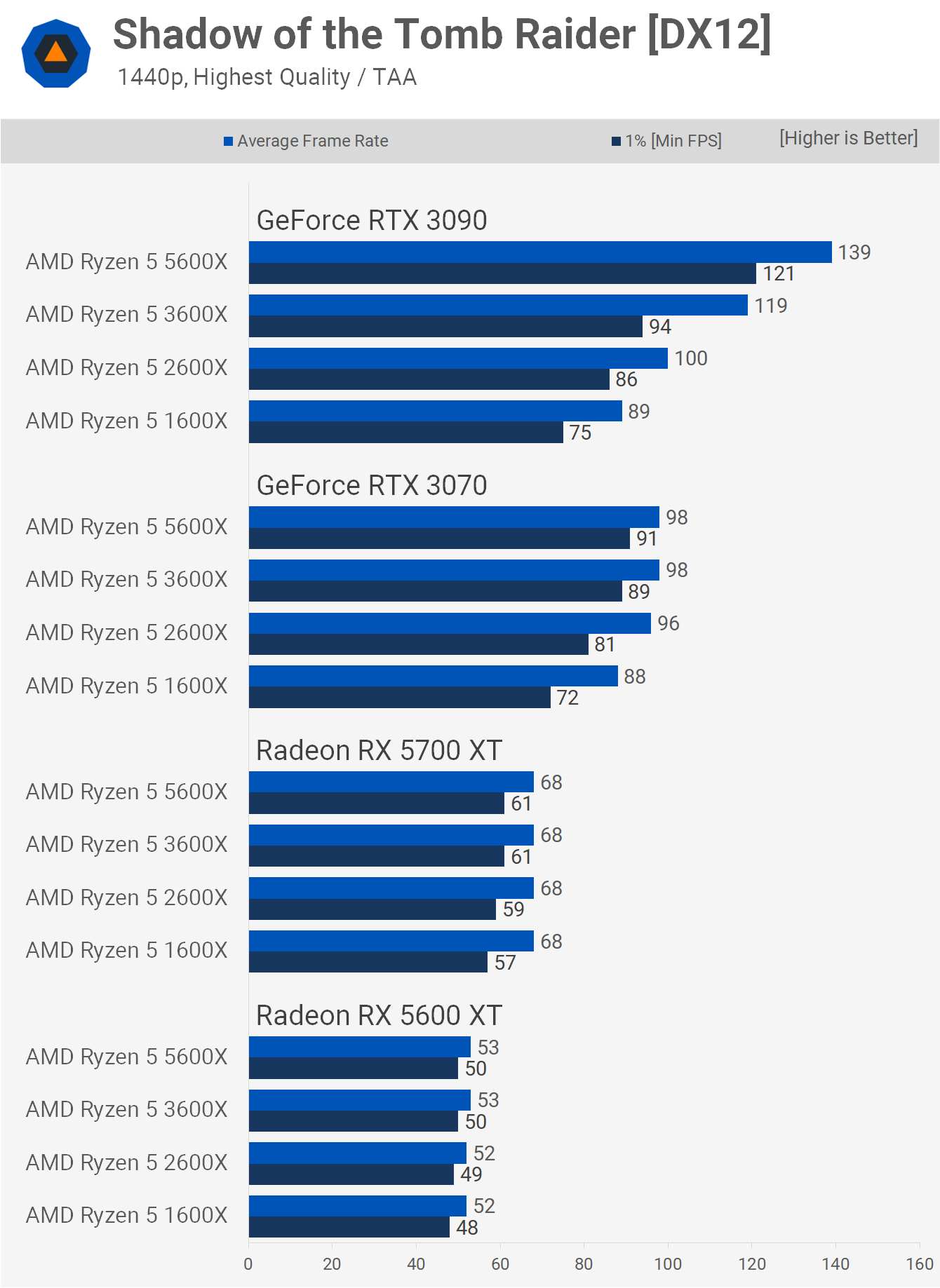
Increasing the resolution to 1440p helps convalesce the CPU bottlenecks seen at 1080p and at present all 4 Ryzen processors are able to get the about out of the 5600 XT and 5700 XT. We're also seeing a situation where the 1600X and 2600X are significantly faster when paired with the RTX 3070 opposed to the 5700 XT. The game was also GPU limited using the RTX 3070 when paired with either the 5600X or 3600X.
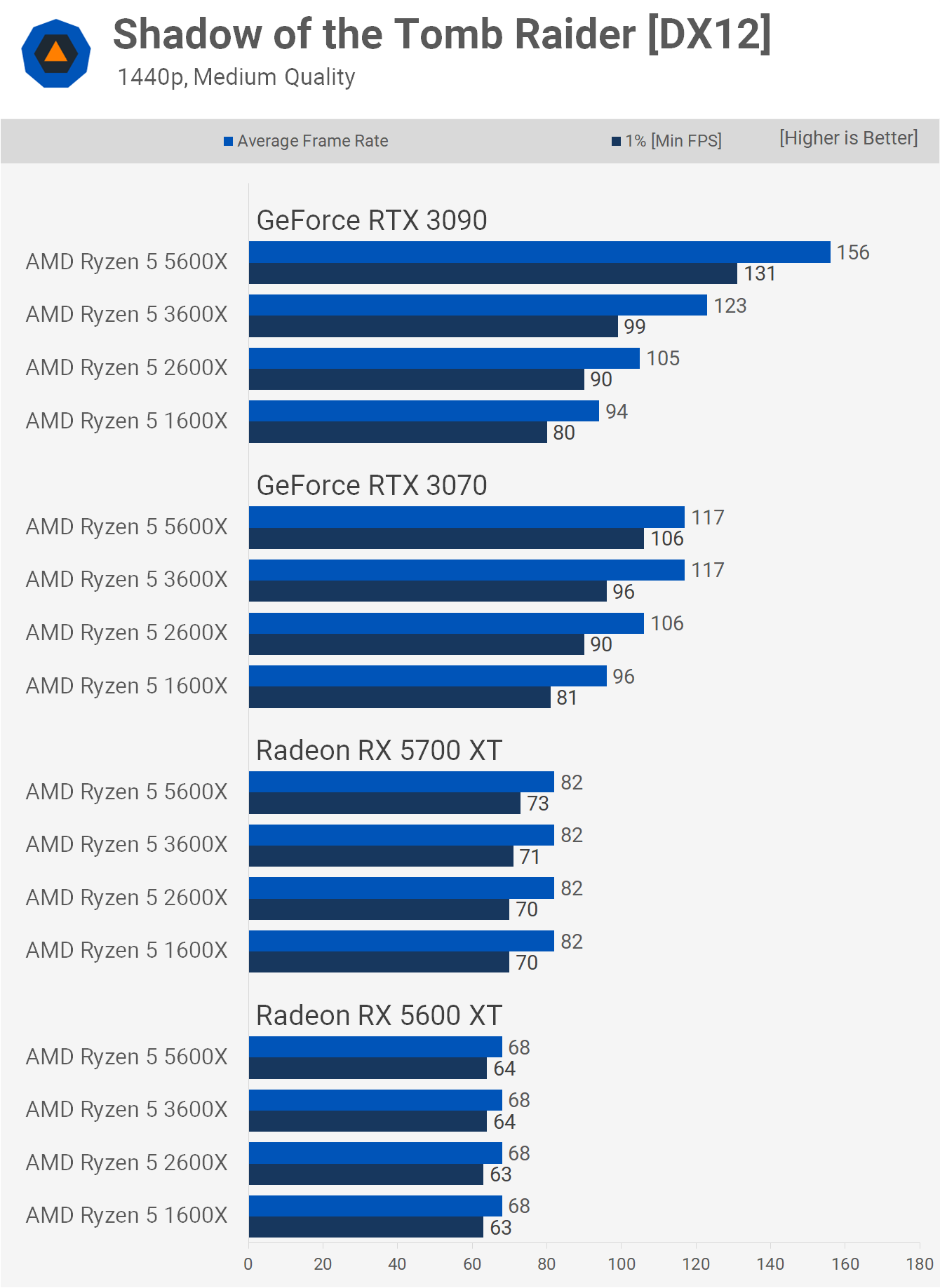
The medium quality results encounter no real difference in performance between the various 6-cadre Ryzen processors when using the 5700 XT or 5600 XT. Nosotros kickoff to run across a scrap of separation with the RTX 3070 and then one time we bound upward to the RTX 3090 the newer Zen iii processor is much faster than the previous generations.
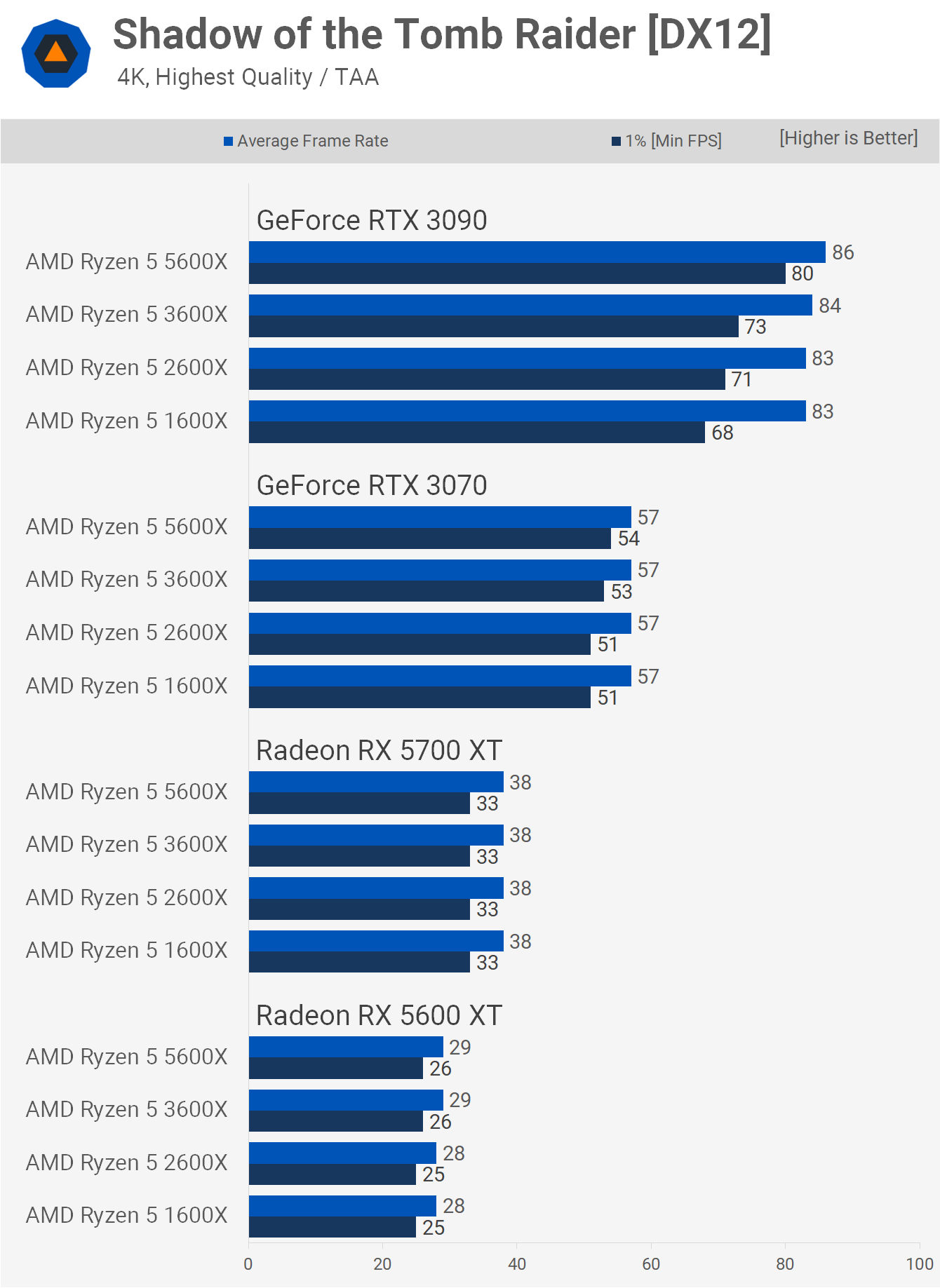
Jumping up to 4K makes the testing far more GPU limited and anticipated, though the mighty RTX 3090 is still powerful enough to see some variation in CPU performance, specially when looking at the ane% low data.
Quite incredibly, the 5600X was however upwardly to 18% faster than the 1600X, thirteen% faster than the 2600X and even x% faster than the 3600X.
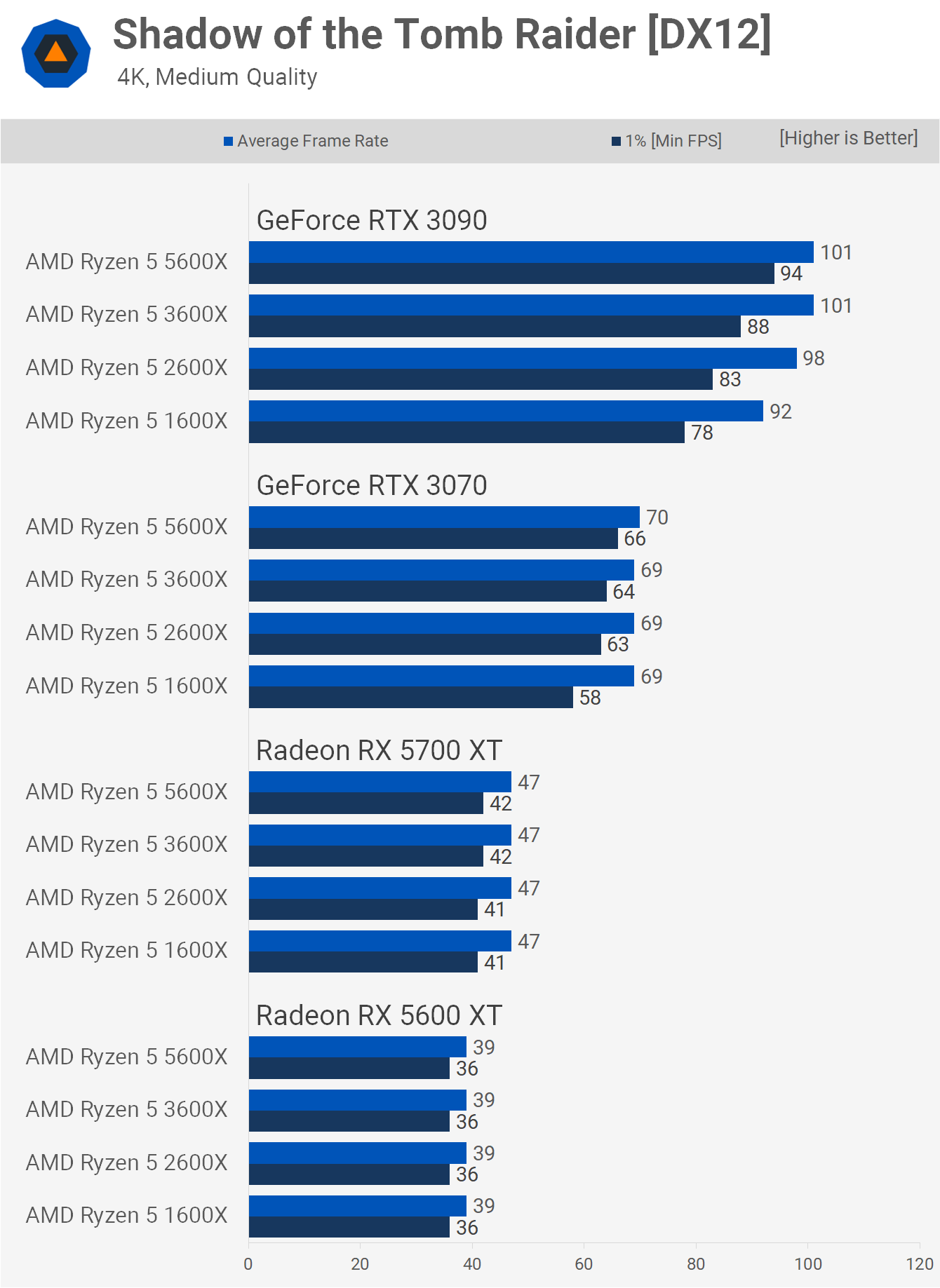
The 4K medium results are similar to what nosotros saw earlier. It's non until you jump up to the RTX 3090 that nosotros start to encounter a noteworthy deviation in functioning.
Sentinel Dogs Legion
In Watch Dogs Legion running at 1080p we're looking at a hard GPU limitation using both the 5600 XT and 5700 XT and this time moving to the RTX 3070 merely had a very minimal negative bear on on performance for the 1600X.
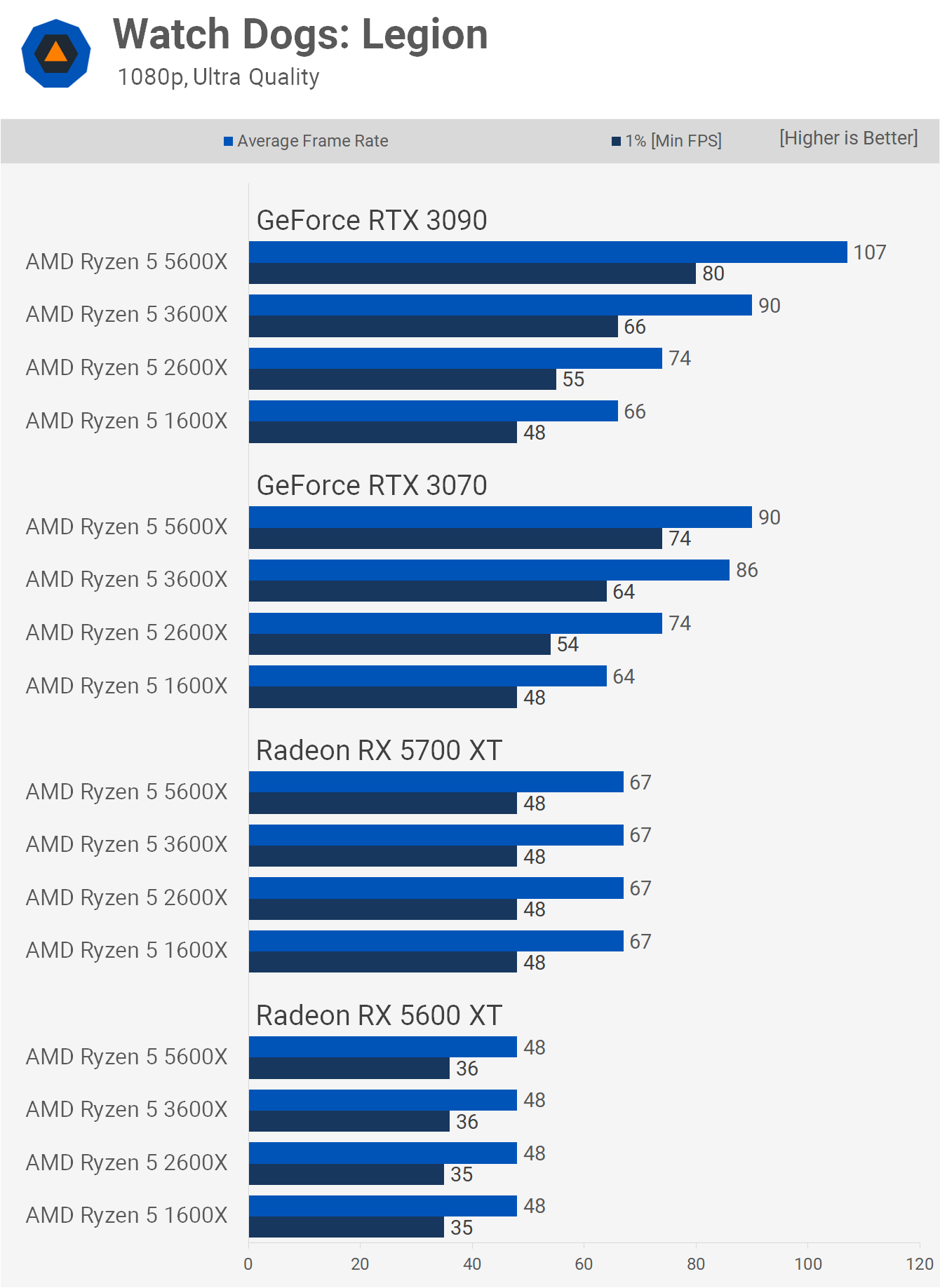
That said with the RTX 3070 it was only the 5600X that was able to find the limits of that GPU under these test conditions.
Then testing at 1080p again but using the medium quality preset results in the mess y'all see below...
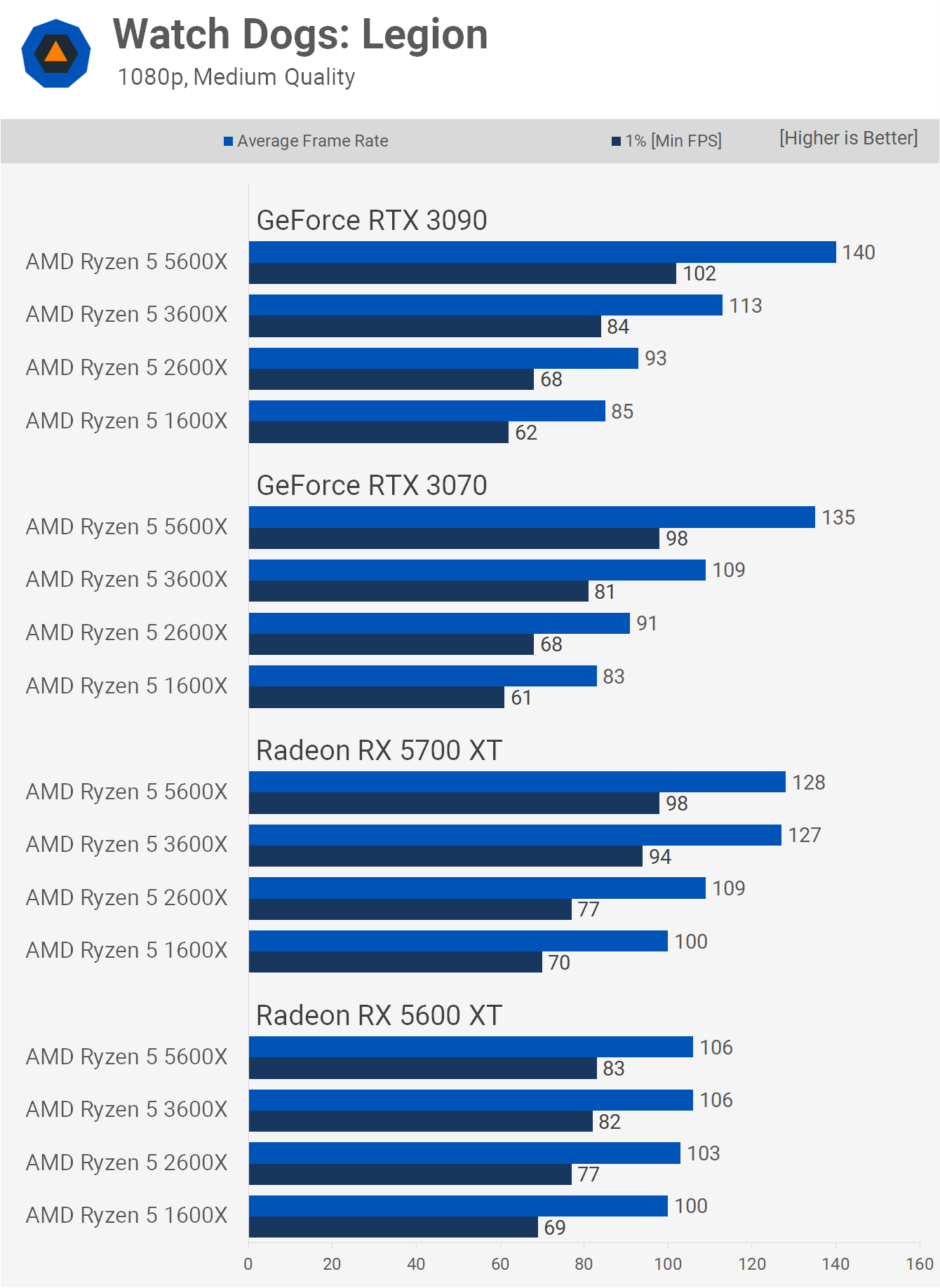
The 5600 XT and 5700 XT results are fairly easy to make sense of. The 1600X and to a degree the 2600X aren't able to max out the 5600 XT, though the Zen+ part comes close. And so with the faster 5700 XT the 1600X and 2600X trail the 3600X and 5600X quite significantly, though you could argue that performance overall was very acceptable. Still with this now mid-range GPU the 5600X was 17% faster than the 2600X and 28% faster than the 1600X.
Where the information gets messy is when we compare the 1600X and 2600X 5700 XT data with the RTX 3070, in fact here you tin too include the 3600X equally well. The 1600X and 2600X were 20% faster when paired with the 5700 XT, and the 3600X was 17% faster. These Ryzen CPUs clearly perform meliorate with the Radeon GPUs under these test conditions and the margins are very like fifty-fifty with the RTX 3090.
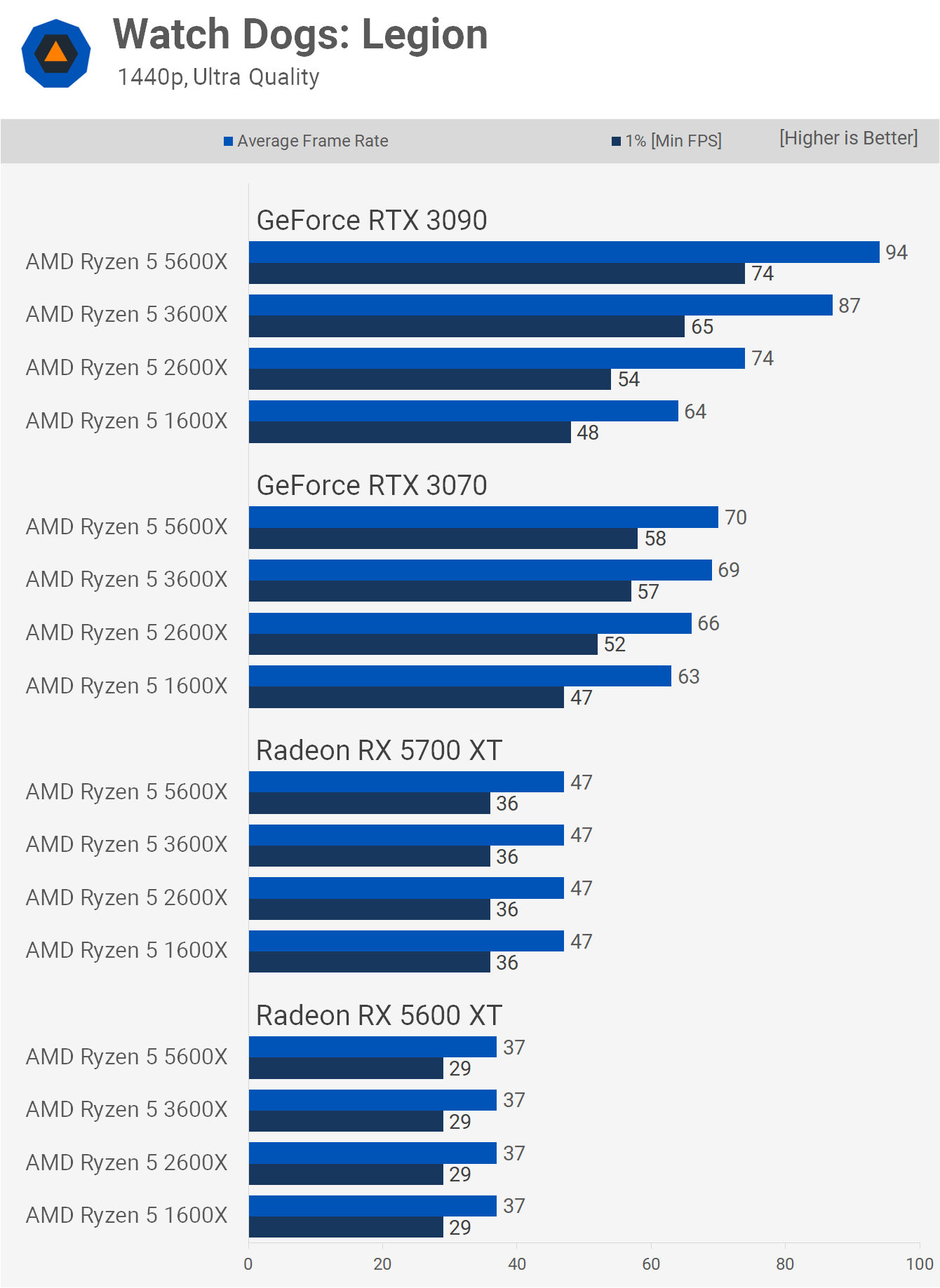
Increasing the resolution to 1440p with the ultra quality settings increased the GPU bottleneck with the RTX 3070 and here the 3600X and 5600X are basically identical in terms of performance. Fifty-fifty the 2600X wasn't far behind though the 5600X was up to 23% faster than the 1600X.
Then if we look at the RTX 3090 data we meet that the 5600X was fourteen% faster than the 3600X when comparison the ane% depression information, 37% faster than the 2600X and 54% faster than the 1600X.
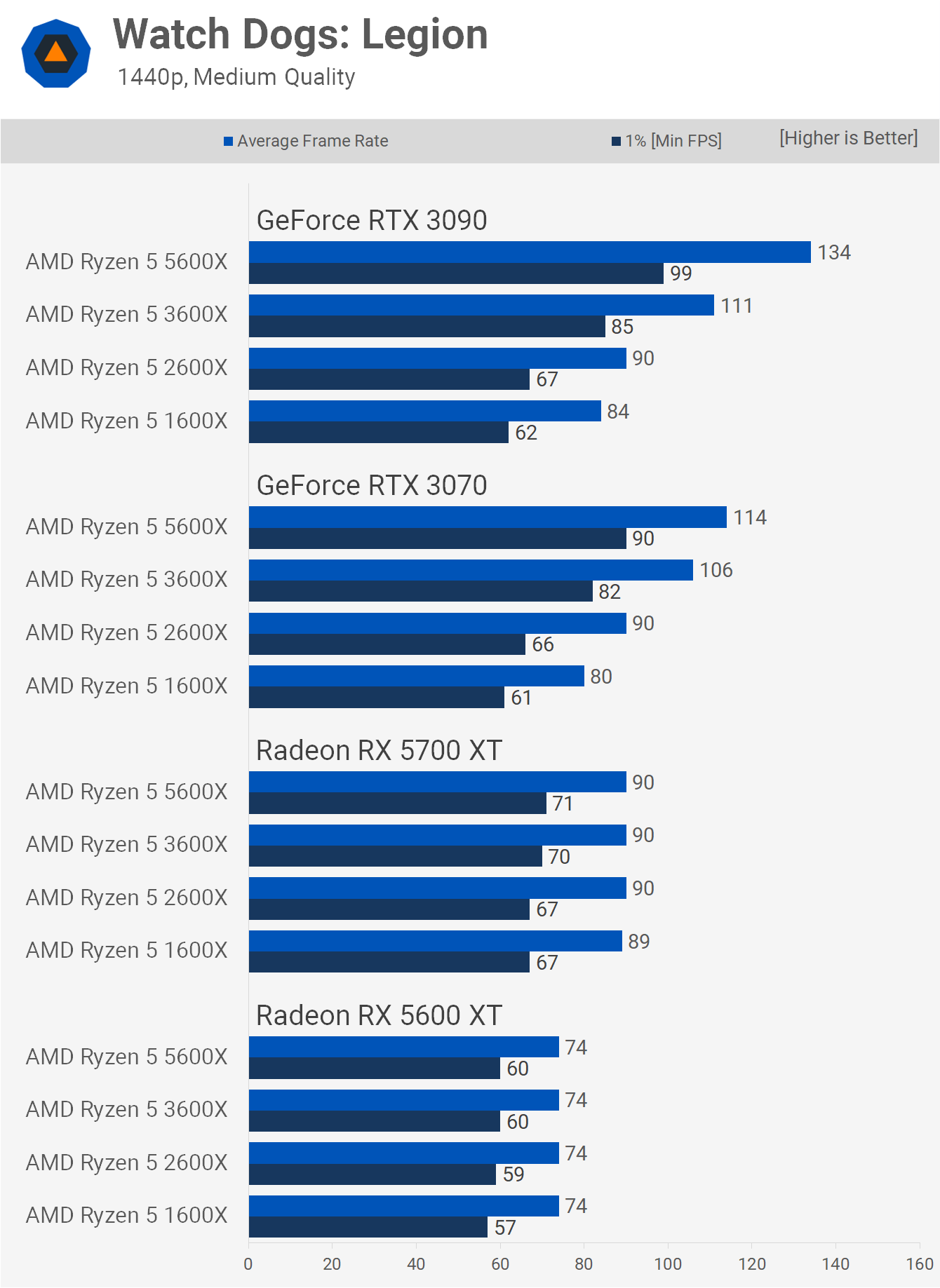
Again the medium quality preset introduces some foreign anomalies in the results, though we accept seen this in other games under certain conditions. Here we're once more seeing superior performance for the 1600X with the 5700 XT opposed to what should be the faster RTX 3070 GPU.
Other than that the results look fairly typical, we're GPU limited with the 5600 XT and 5700 xT while we're CPU limited with the RTX 3070 for the 1600X, 2600X and 3600X.
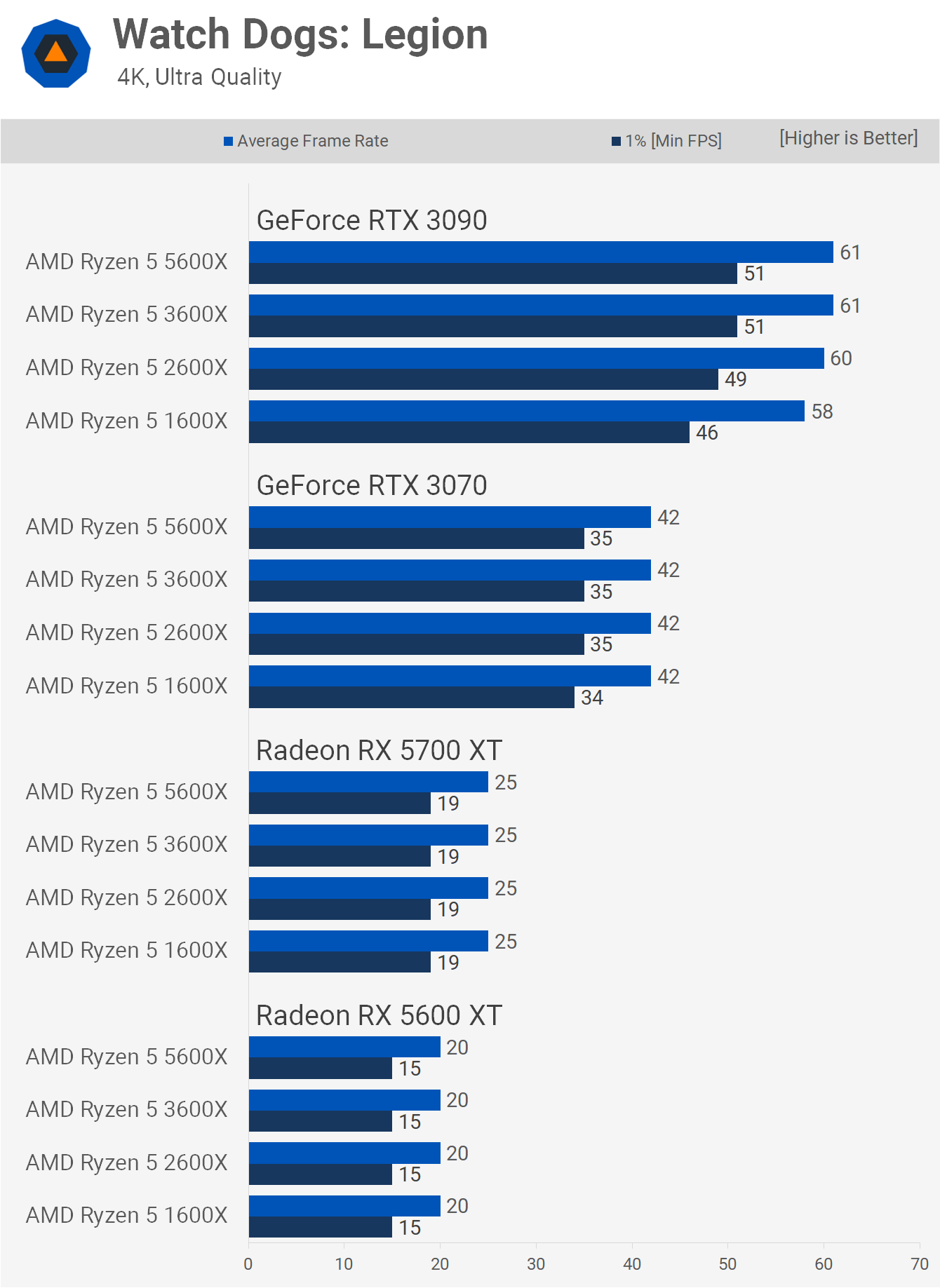
Increasing the resolution to 4K with the ultra quality settings saw Picket Dogs Legion become well-nigh entirely GPU leap -- in fact information technology was with the RTX 3070 and slower. Nosotros saw some small variation in performance using the 3090, hither the 5600X was up to xi% faster than the 1600X.
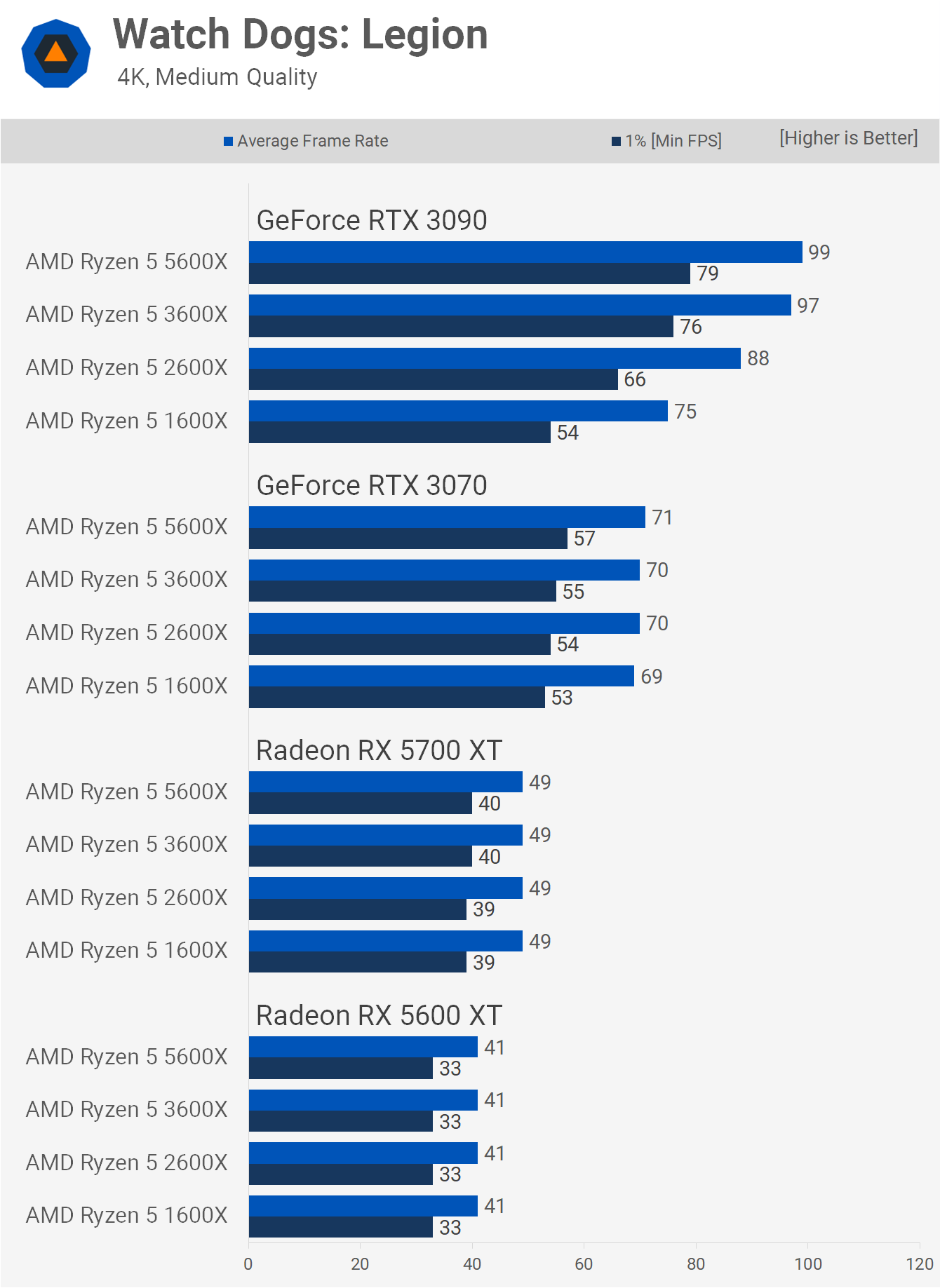
And then at 4K with the medium quality setting we find the margins open up with the RTX 3090, though the 3600X is able to closely match the 5600X.
Assassin's Creed Valhalla
The last game nosotros're going to await at is Assassin's Creed Valhalla. At 1080p using the ultra quality preset we detect that the results are fairly heavily GPU limited with the 5600 XT, 5700 XT and RTX 3070. There is a small drop in 1% slow performance for the 1600X and 2600X with the 3070, but other than that we are looking at heavily GPU limited results.
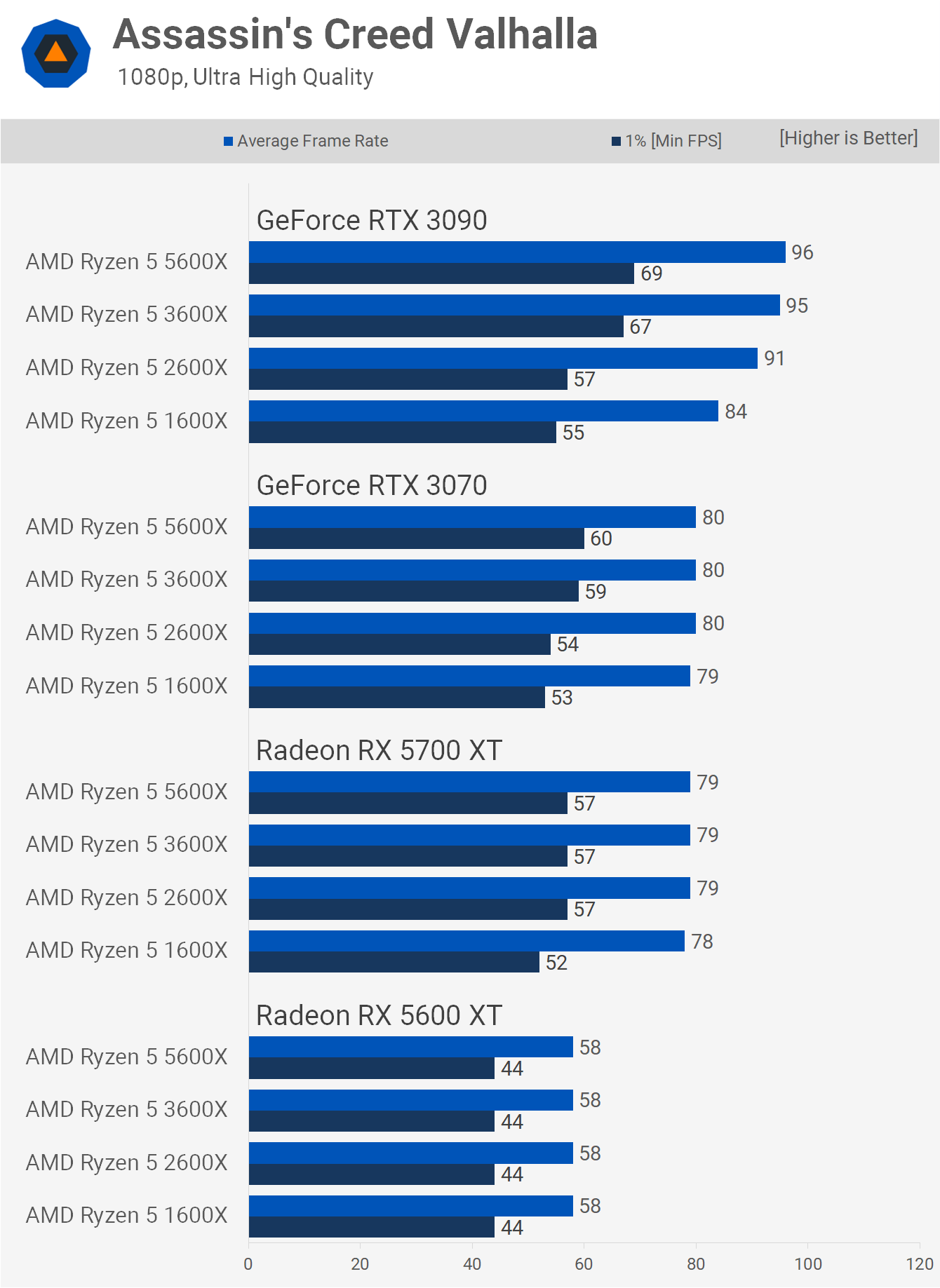
Then with the RTX 3090 the 5600X was up to 3% faster than the 3600X, 21% faster than the 2600X and 25% faster than the 1600X. It's worth noting that the 5700 XT is like to the RTX 3070 in terms of operation due to the fact that this AMD sponsored championship is highly optimized for Radeon GPUs.
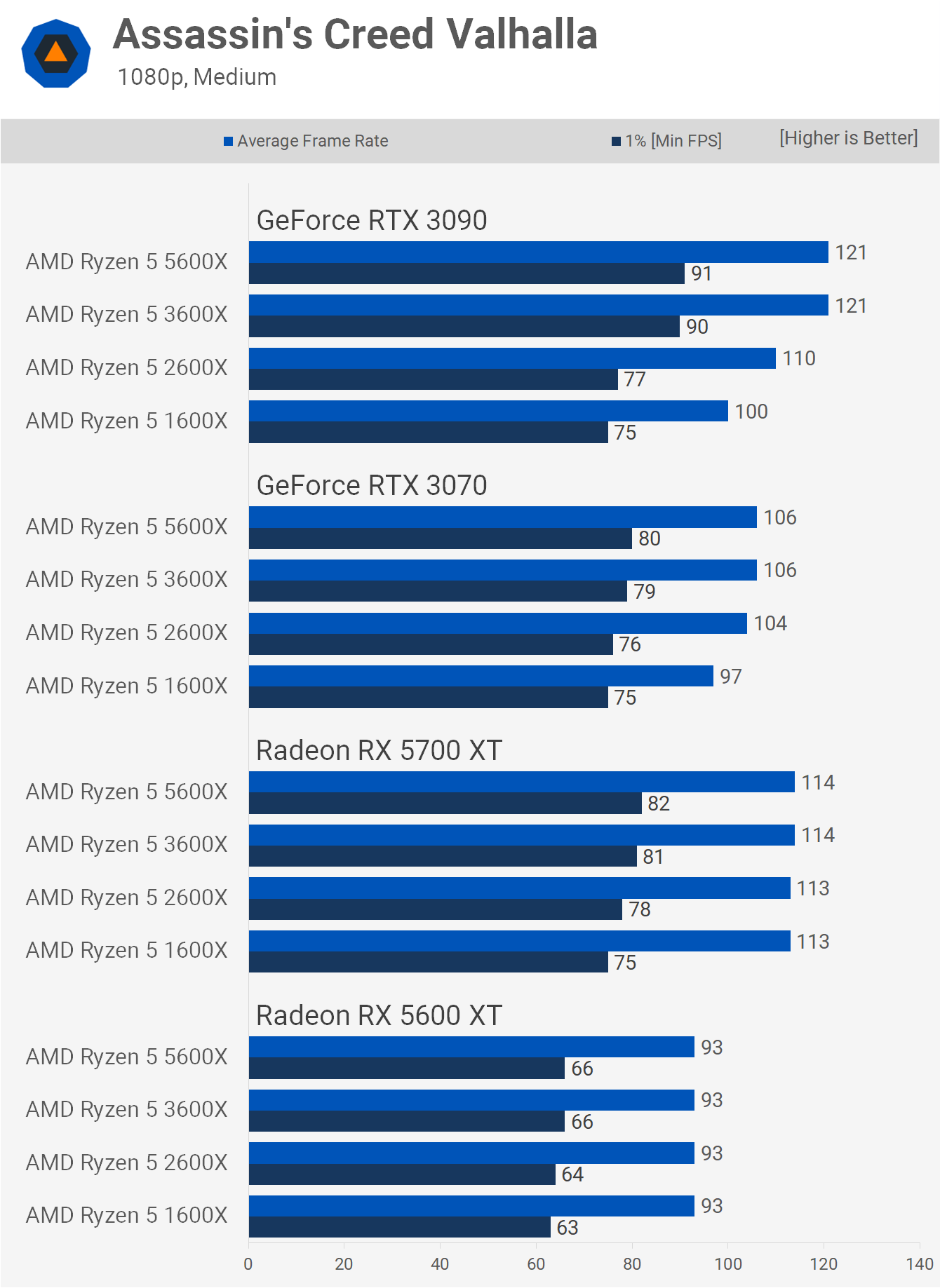
The margins using the medium quality preset actually aren't that different, over again all four CPUs come close to maxing out the 5600 XT and 5700 XT while we see a small variation in performance using the RTX 3070. And then with the 3090 the 1600X and 2600X are limiting performance while the 3600X and 5600X announced to be maximising what the 3090 is capable of at this resolution.
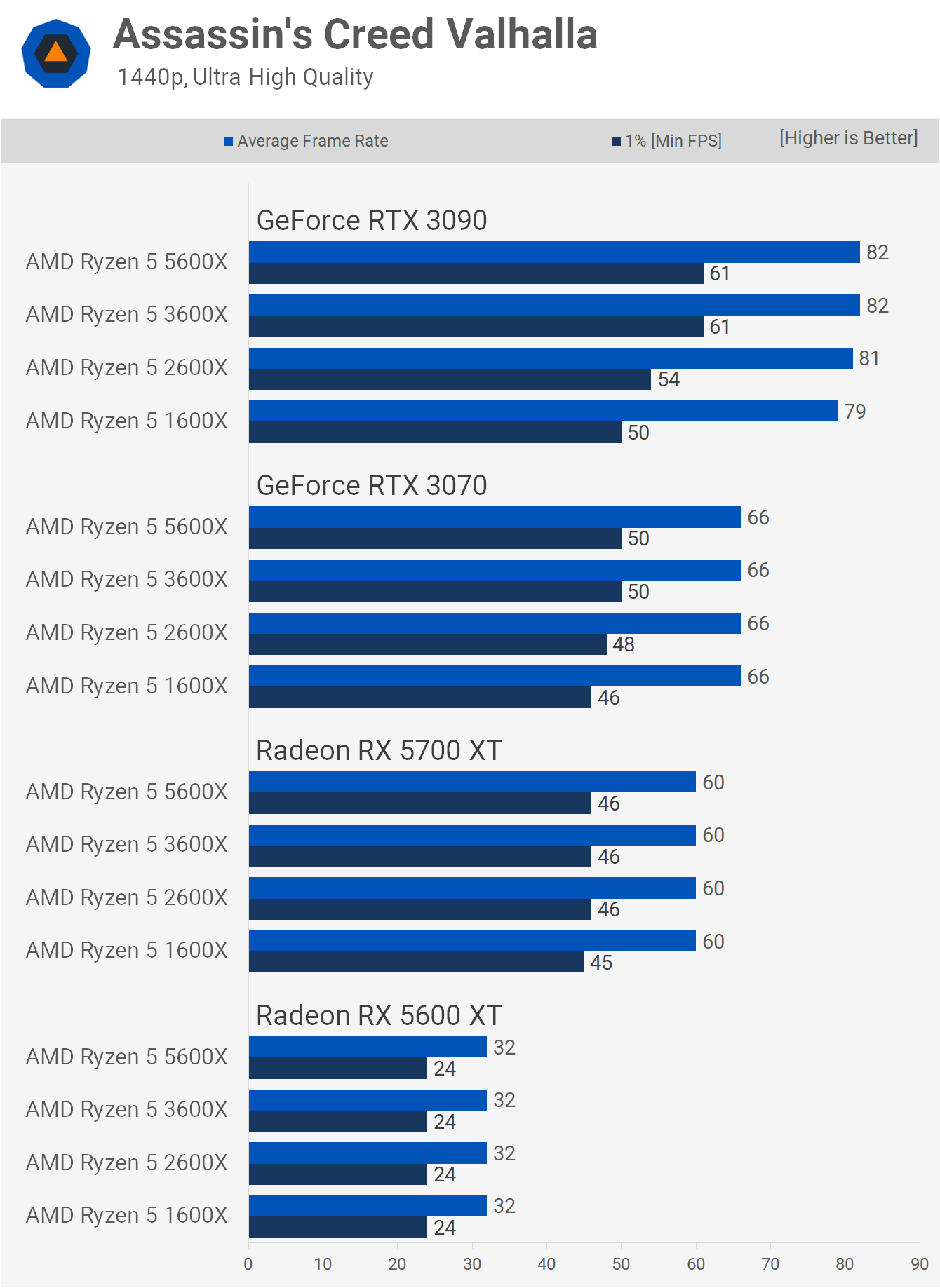
Jumping upwardly to 1440p with ultra visual settings allows the RTX 3070 to pull ahead of the 5700 XT, though that'due south non really what we're interested in, rather it's the fact that all four CPUs are able to max out the 5600 XT, 5700 XT and RTX 3070. We find the limits of the 1600X and 2600X with the RTX 3090, peculiarly when looking at the 1% low performance.
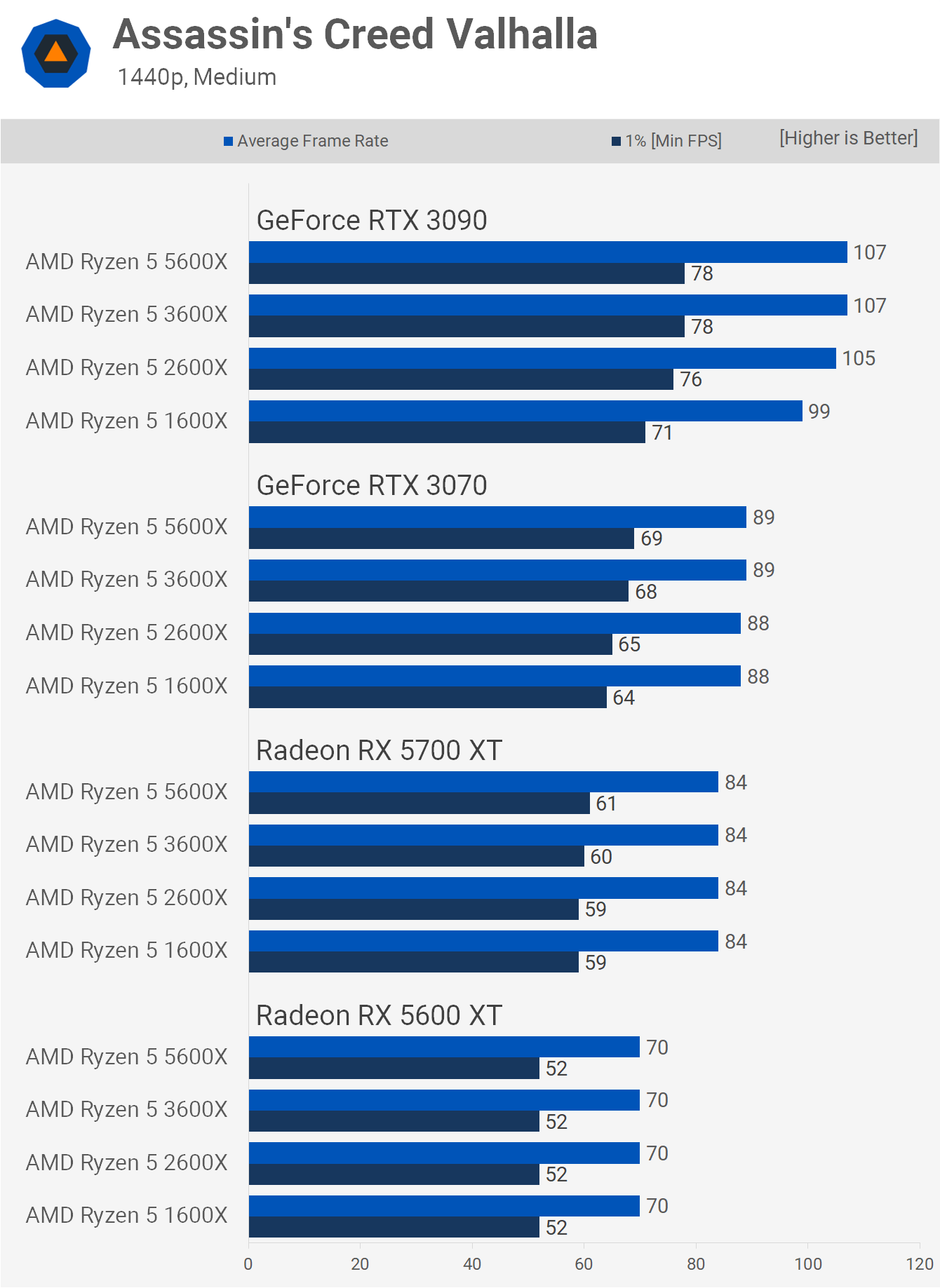
Lowering the quality with the medium preset helps reduce CPU load and allows the 1600X and 2600X to deliver better more than consistent one% low performance when paired with the RTX 3090, this isn't totally unexpected and we have seen this sort of behaviour a number of times in the by.
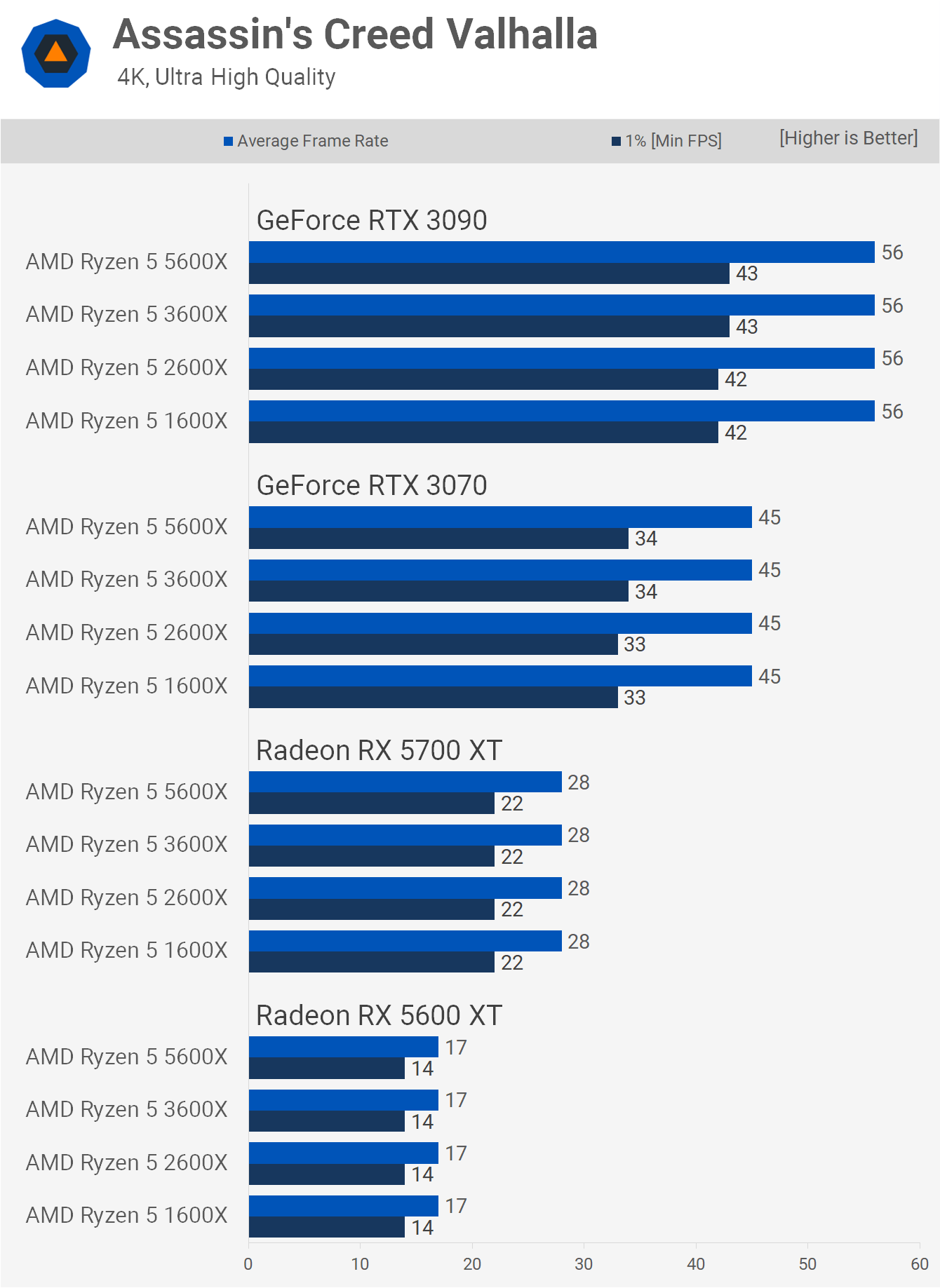
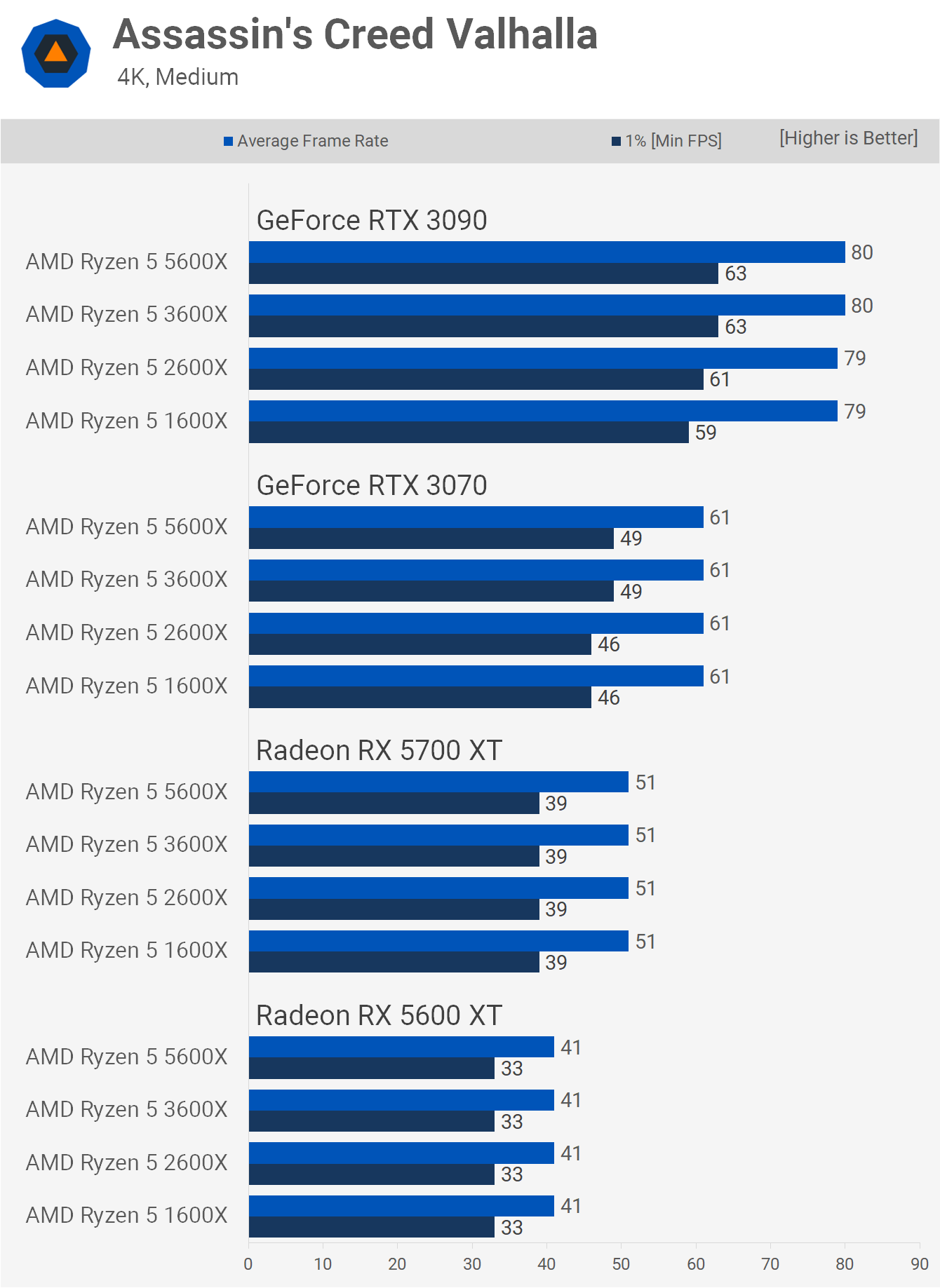
Finally at the 4K resolution the game became extremely GPU spring and this was the example for both the ultra and medium quality settings, so non much to say hither.
Performance Summary
A lot of mixed information betwixt resolutions and games, so let's move on to accept a look at the half dozen game averages.
The average 1080p ultra data looks pretty normal. On average across the one-half dozen games tested the four Ryzen v CPUs maxed out the 5600 XT and 5700 XT, with only a minor variation in 1% low data with the 5700 XT. So as we upgrade to the faster RTX 3070 the 1600X typically saw no existent operation improvement. The 2600X simply saw a 10% boost while the 3600X became 23% faster and the 5600X 31% faster.
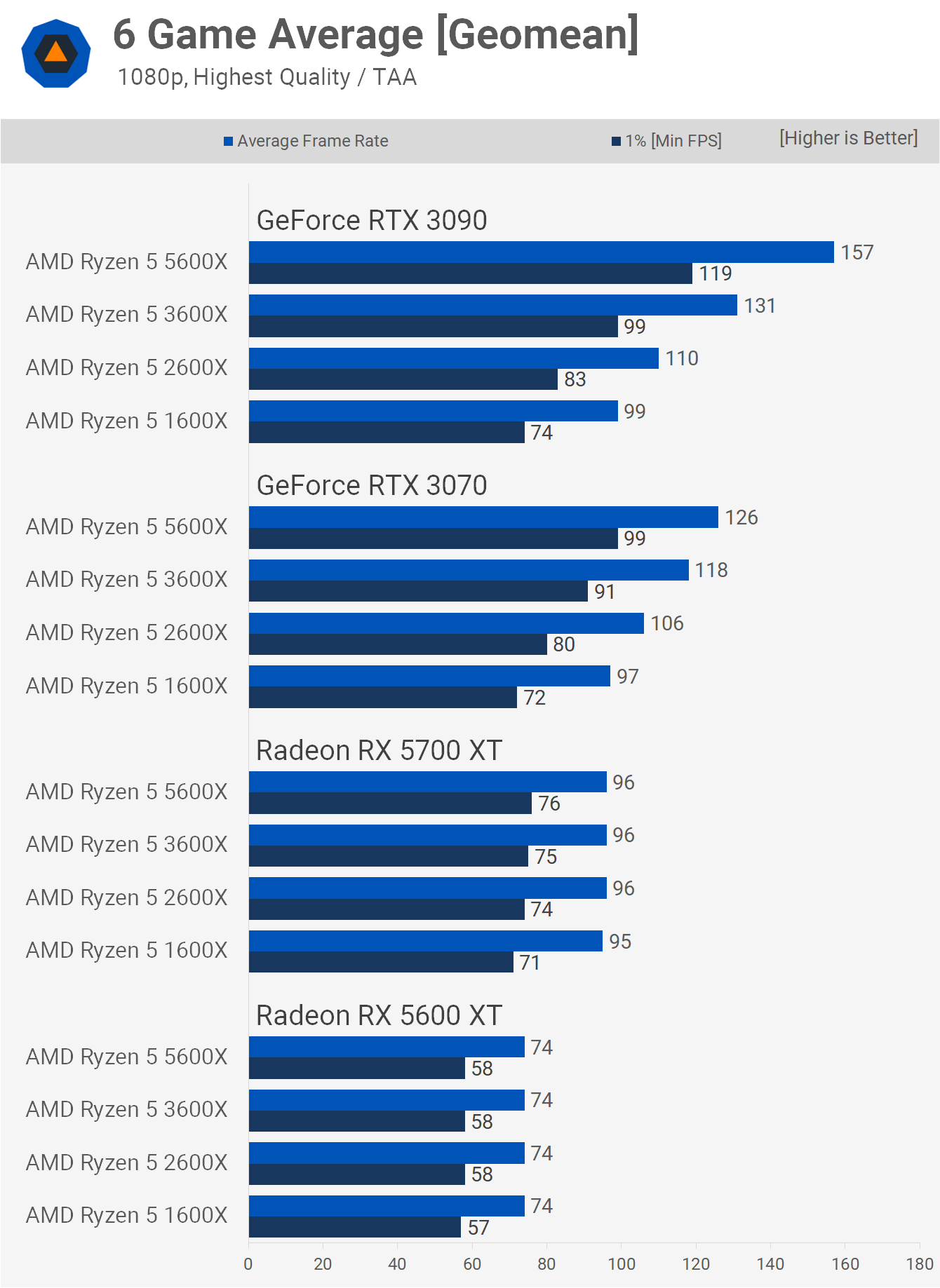
The margins widened further with the flagship RTX 3090, hither the 5600X was on average twenty% faster than the 3600X, 43% faster than the 2600X and 59% faster than the 1600X, that's basically double the margins seen with the RTX 3070.
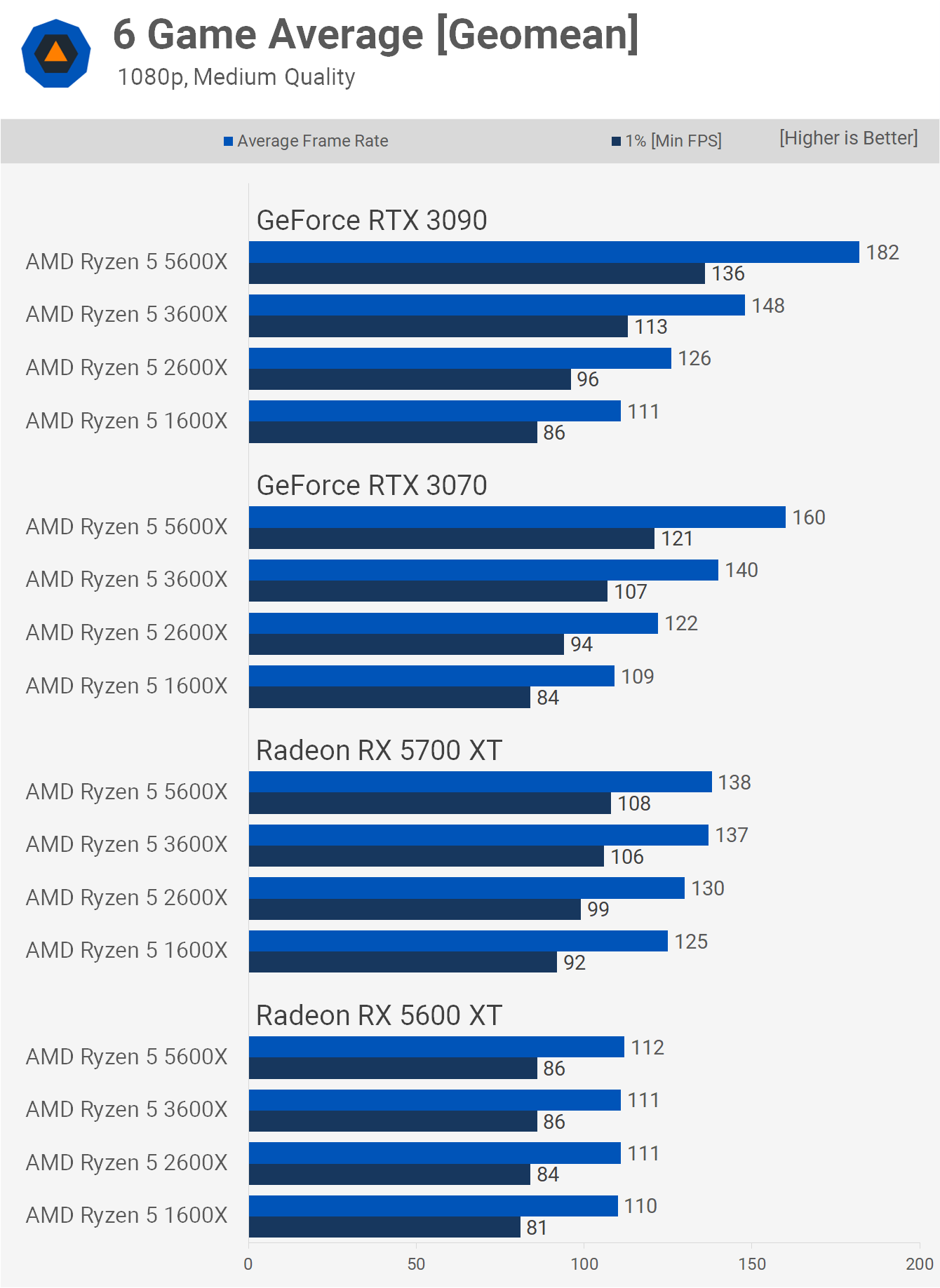
With medium quality settings at 1080p we as well see lilliputian to no difference betwixt the various CPU tested. The margins opened up with the 5700 XT and now the 5600X was up to 17% faster than the 1600X, though it was basically matched past the 3600X.
So as we saw numerous times, the 1600X and 2600X go backwards in terms of fps performance when moving to the RTX 3070, in this case the average frame rate dropped by 15% for the 1600X and 7% for the 2600X. The 1600X, 2600X and fifty-fifty the 3600X see a small actress boost when upgrading from the RTX 3070 to the 3090, just a 6% uptick in the case of the 3600X while the 5600X gained a further fourteen% performance.
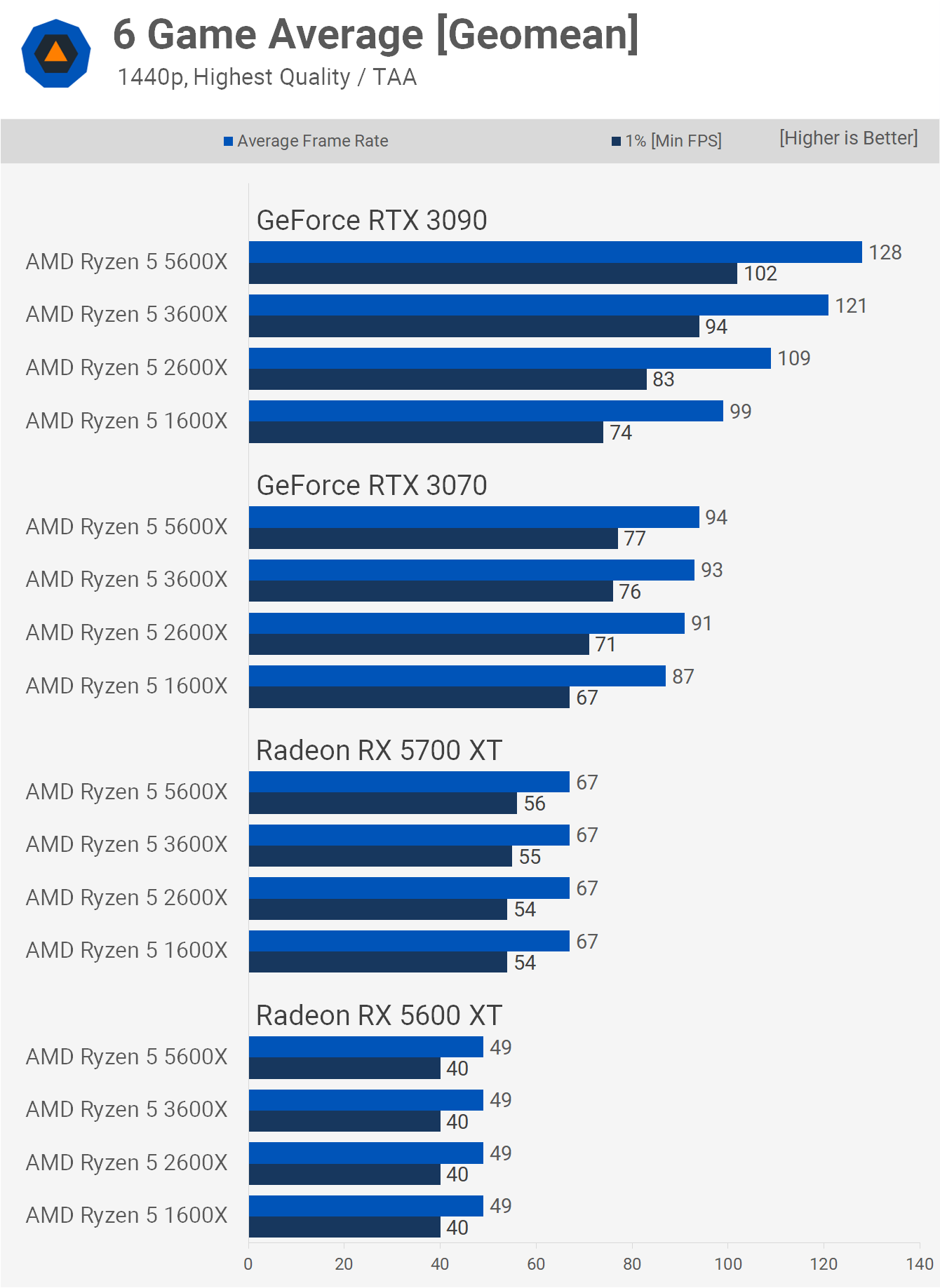
At present at 1440p using the ultra quality settings we discover that all 4 CPUs were able to max out the 5600 XT and 5700 XT, while we see up to a 15% increase in performance from the 1600X to the 5600X with the RTX 3070. Of course, the real margins are seen with the RTX 3090 where the 5600X was on boilerplate up to nine% faster than the 3600X, 23% faster than the 2600X, and 38% faster than the 1600X.
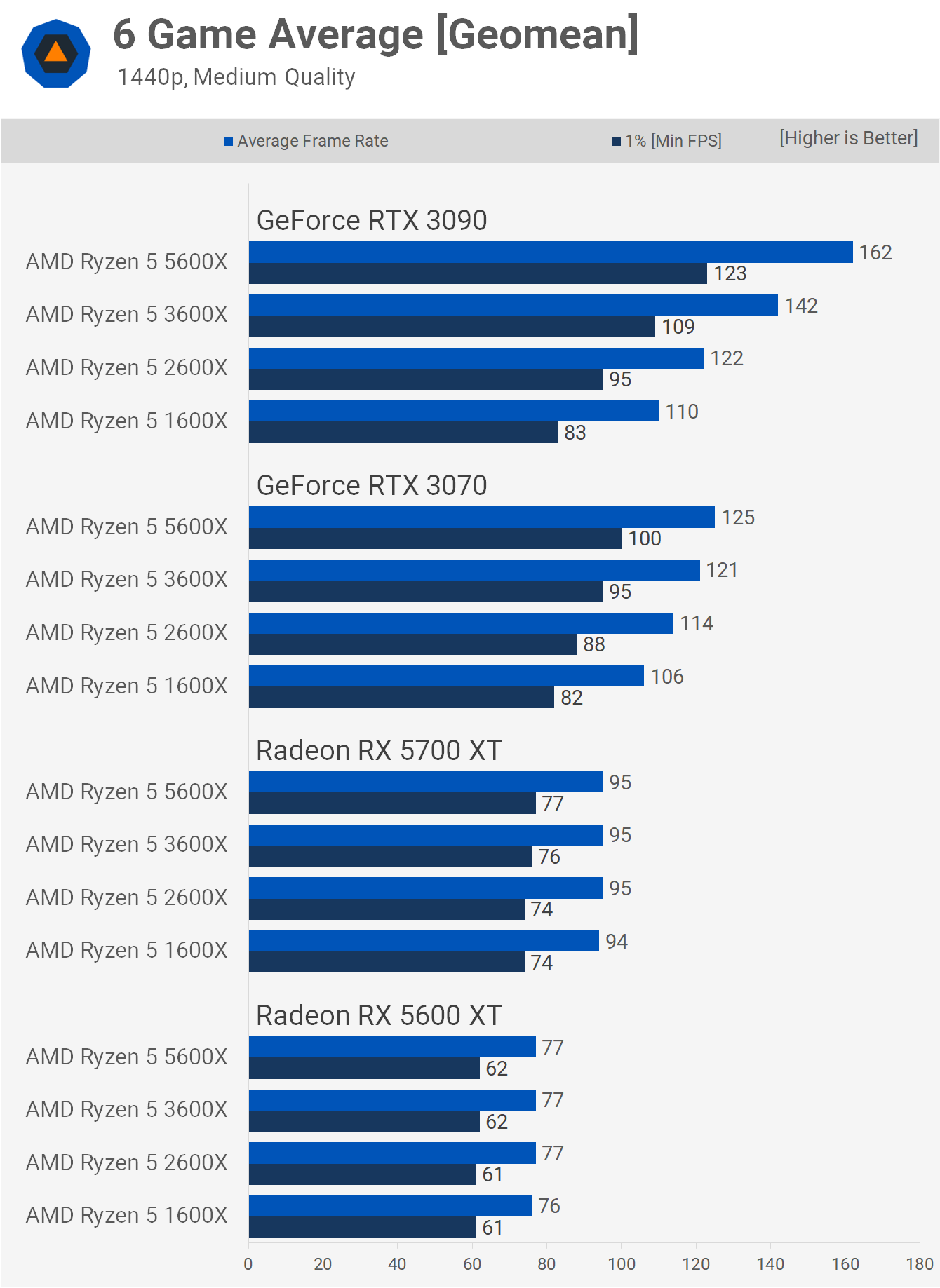
The 1440p medium quality results are adequately like to what nosotros simply saw though CPU bottlenecking with the RTX 3070 is more evident hither.
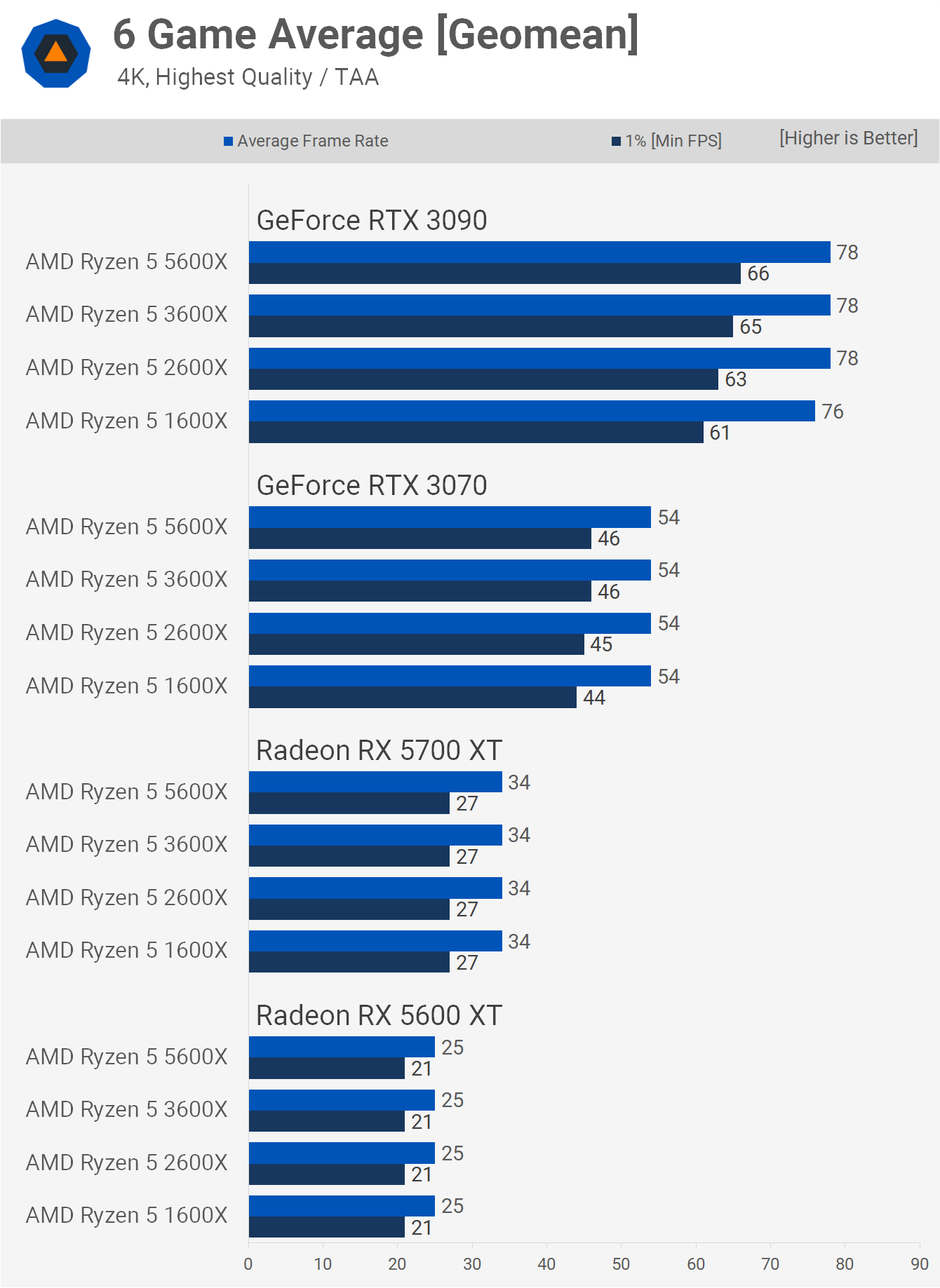
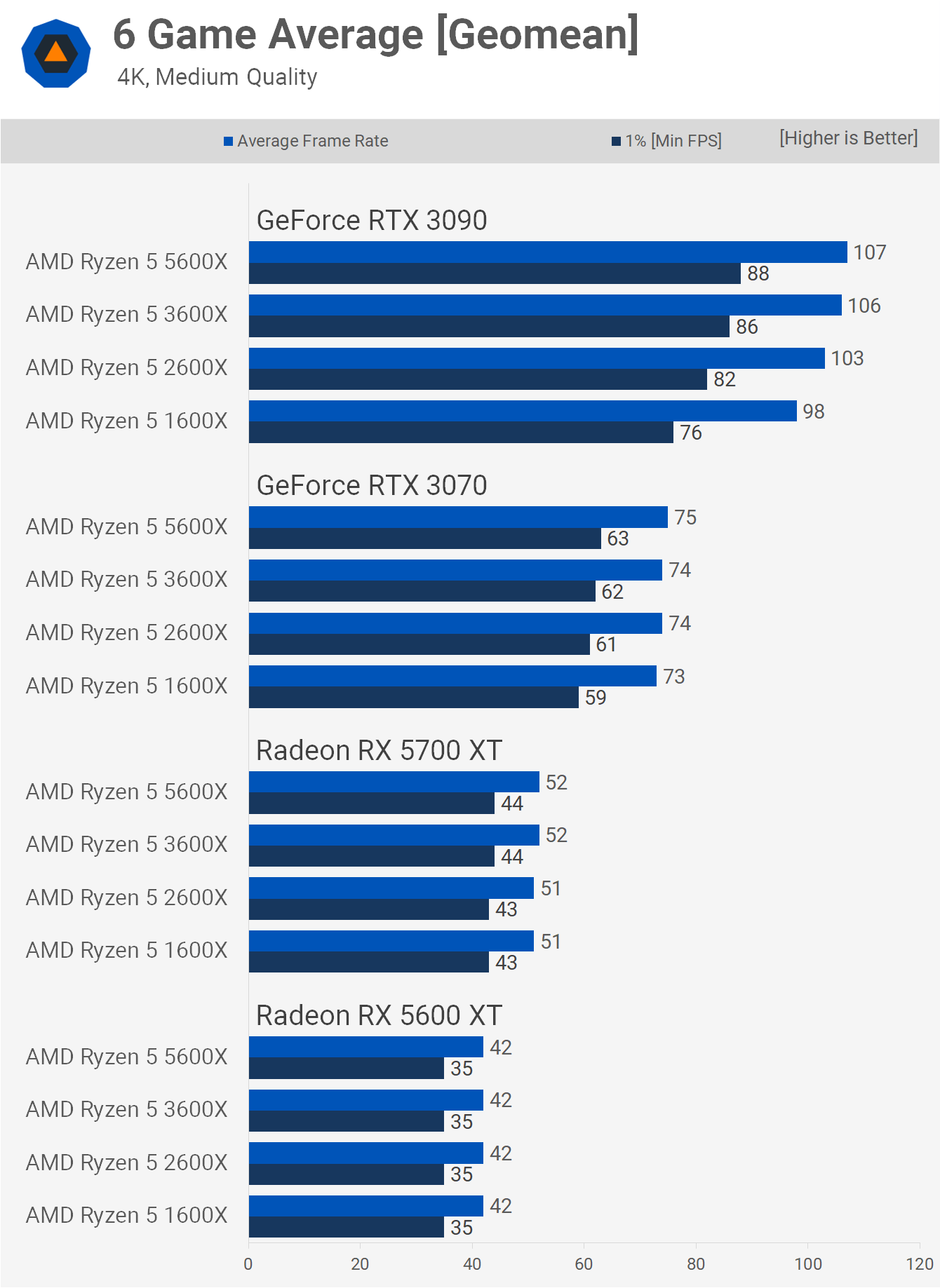
And so every bit nosotros saw time and time once again, the 4K ultra functioning is similar across the board with only small-scale margins for the ane% low operation seen when using the RTX 3090. Those margins opened up a little scrap using the medium quality settings though if you're running an RTX 3090 chances are you won't be doing so with a 1st or 2nd generation Ryzen processor.
What We Learned
That was an incredible amount of information and we've got to admit we're walking about from this one with more than questions than answers. We want to retest a few of these games with the 6900 XT, RX 6800 and RTX 2080 Ti while too including a few Intel CPUs for reference.
Equally for what nosotros did learn here, there are a few takeaways.
First, while a massive pace forward for AMD, Zen wasn't the most efficient architecture for gaming and while that won't necessarily be news to any of you lot it was interesting to run across how it compared against Zen+, Zen two and Zen 3 across a range of settings and GPU hardware.

Nosotros know for example that the Ryzen 5 1600X has anile better than the Core i5-7600K, and then it certainly wasn't a bad buy and if y'all're somewhat realistic about the hardware configuration, a function similar the 1600X is nevertheless respectable even today. Of course, you tin can test it with an extreme GPU like the RTX 3090 and claim it'south pathetic equally the R5 5600X is often over 50% faster, but pair it with a more than reasonable budget combo like the 5600 XT or even the 5700 XT and it does quite well.
Testing with a latest generation GPU like the RTX 3090 does help to highlight just how far AMD has come up with Ryzen in a few years. Zen+ which is but a refined version of Zen, provides on average a 14% boost in gaming performance when CPU limited. Then from Zen+ to Zen 2 we encounter a larger 17% uptick and the most contempo update (Zen three) provided a further 23% functioning uplift.

Without question the gaming performance of the AMD Zen compages has improved by leaps and bounds, though you won't always see big functioning gains when upgrading your CPU because equally we just saw you lot need the right GPU to unleash the additional processing power. So if you lot're currently using an RTX 2060 or 5600 XT (or perhaps something slower), and your current CPU is a Ryzen 1600X or 2600X, then upgrading to a Core i5-10600K or Ryzen 5 5600X, for example, won't net you much additional performance.
This kind of supposition volition always depend on the games you play and settings -- what'south optimal for you might not be optimal for a different gamer -- but the dominion will utilise when you are hitting a balanced choice of CPU and GPU.

Nosotros should also quickly discuss core counts, since that came upward a lot in our previous CPU/GPU scaling characteristic which focused on Zen 3 parts. We desire to reiterate what nosotros said in our Ryzen 5 5600X review, and that is that gamers shouldn't focus on CPU core count and the simply existent consideration should be CPU performance and how much CPU performance you actually need.
For gaming all you demand from the Zen 3 range is the half-dozen-cadre/12-thread model right now, but that'south not to generalize by saying any half-dozen-cadre/12-thread processor is all you need for gaming because as we've seen here, half dozen-cadre/12-thread performance can mean simply about anything with the 5600X up to 100% faster than the 1600X in the well-nigh farthermost scenarios, so just focus on CPU performance and get over this core count obsession for gaming.
In that location's enough more testing to be done and we're keen to add Intel'due south upcoming 11th-gen Core serial to the mix shortly. If you enjoyed this feature, you can say cheers to Steve who dedicated an insane amount of time to this testing.
Shopping Shortcuts:
- Nvidia GeForce RTX 3060 Ti on Amazon
- Nvidia GeForce RTX 3070 on Amazon
- Nvidia GeForce RTX 3080 on Amazon
- Nvidia GeForce RTX 3090 on Amazon
- AMD Ryzen 9 5950X on Amazon
- AMD Ryzen 5 5600X on Amazon
- AMD Ryzen 5 3600 on Amazon
- AMD Ryzen 5 2600 on Amazon
- AMD Ryzen five 1600 on Amazon

Source: https://www.techspot.com/article/2201-four-years-of-ryzen-5-gpu-scaling/
Posted by: tiptondecten.blogspot.com
0 Response to "4 Years of Ryzen 5, CPU & GPU Scaling Benchmark"
Post a Comment